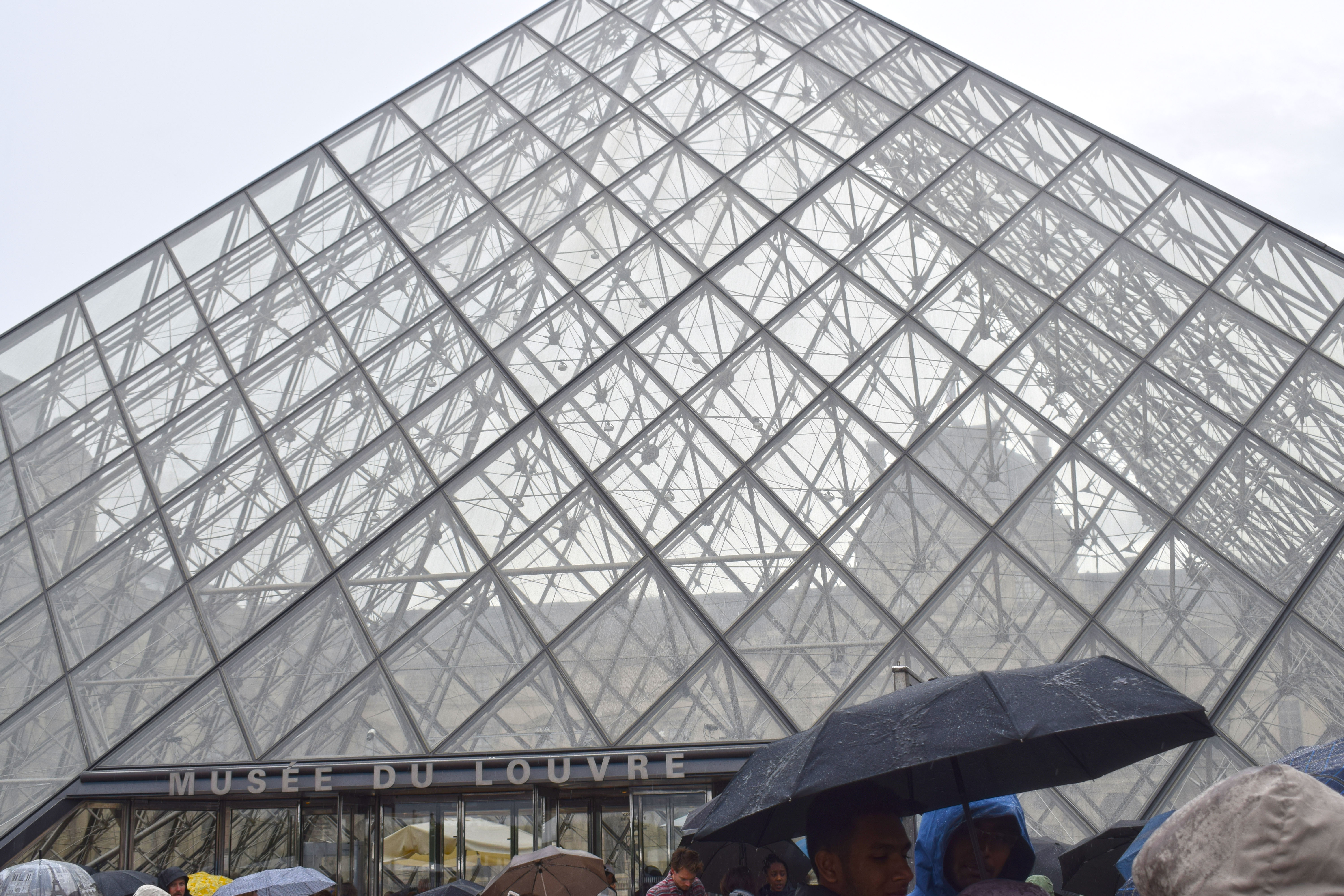


” A Sanctuary for the Soul, Nourished by Centuries of Art”
–Salutparis.com
Things You Need To Know:
How To Get There:
Metro: Palais-Royal / Louvre Museum (lines 1 and 7)
Pyramids (line 14)Bus: No. 21, 27, 39, 67, 68, 69, 72, 74, 85, 95
Taxi: Drop-off area at the Carousel roundabout. The closest pick-up area is at Place André Malraux.
Batobus: Louvre stop, Quai François-Mitterrand
Entrances: There are 3 entrances. Elevators at the Pyramid are available for the disabled, wheelchairs, and strollers (prams)
Pyramid is the most popular. GREEN LINE- visitors with a ticket/ Paris Museum Pass ORANGE LINE- visitors without tickets BLUE LINE- Priority access for disabled visitors/ museum staff
Carousel– 99 Rue de Rivoli
Richelieu– Rue de Rivoli is reserved for groups and museum members
Hours: https://www.louvre.fr/en/visit/hours-admission
The museum is CLOSED on TUESDAYS.
9:00 AM to 6:00 PM Monday, Thursday, Saturday and Sunday
9:00 AM to 9:00 PM Wednesday and Friday
Room Closures: Check the website in advance of your ticket purchase to see which rooms will be closed during your visit. Napoleon’s Apartments are not open every day.
Tickets: https://www.ticketlouvre.fr/louvre/b2c/index.cfm/home
During heavy tourist seasons- online ticket purchase is necessary. Onsite ticket purchase sales are only conducted during the low season depending upon availability. Before choosing your ticket- think about how you want to tour the Louvre.
Tickets should ONLY be purchased from a verified seller. If you are touring independently- buy direct from the Louvre website a MINIMUM of one month in advance. When purchasing tickets you will be asked to select a day and a time. It is recommended that you arrive at least 15 min before your timed entry. Late arrivals risk losing entry. If you purchase through a tour agency- you will most likely receive a voucher that will need to be exchanged for a ticket onsite. After that exchange, you can get in your timed entry line.
If you are hiring a tour guide: be sure and do your research by reading reviews, checking blogs and regulatory agencies. It is likely that you will receive a voucher which you will give to your tour guide. There is no such thing as skip the line. Everyone stands in their timed ticket entry line to clear security. The only line you are “skipping” is the purchase ticket line. Your tour guide may give you an address that is not the Louvre to meet- once the group gathers, the guide will then escort you to the site.
The Paris Pass: https://parispass.com/en
The Paris Pass lets you enter a wide number of attractions, museums, and more by paying one price for the pass. It is essential that you do a cost benefit analysis to make sure you are getting your money’s worth. If you choose the Paris Pass then you must go to the Louvre website and BOOK YOUR DAY AND TIME Directions on how to make these arrangements are detailed on both the Paris Pass and the Louvre ticket page.
How To Tour-
Tour Groups: tours come in all varieties from brief- see the highlights to all day affairs. You need to decide what is right for you. Group size is an important consideration- the larger the group the harder it is to see the object as people gather around it. Check to make sure your guide uses audio headphones so that you can hear him clearly. Look at the itinerary- are all the art pieces you want to see available to you, how much time is spent in gift shops, bathrooms, eating establishments etc.
Individual Tour: Here you get to see what you want, discover new art, move at your own pace, spend as much or as little time as you please, eat, rest and use the restroom based on your needs. My preference is always to try independent touring. Touring the Louvre might seem overwhelming, but the itinerary below will take you by most of the popular pieces.
Tour the Louvre:
Brief History: The Louvre is not only the largest art museum in the world, but the most visited as well. In 2023 it hosted 8.9 million visitors- bumping the Vatican Museum to second place. Long before the Louvre became an art museum, it was a fortress. The 12th century foundations can be seen in the Medieval Louvre. Charles V (14th century) converted the fortress to his home. In 1546 Francois I began to redesign the residence into a Renaissance style palace for the monarchy. Over the next century, French Monarchs added wings and established rooms. Louis XIV ,who directed most of his budge towards the development of the Palace of Versailles, still found resources to add to its development The French Revolution established the royal palace as a museum. It opened to the public on August 10, 1793 with 500 pieces of art on display. A 1980s renovation saw the addition of I. M. Pei’s glass and metal pyramid in the courtyard to serve as the main entrance. The museum’s collection consists of 600,000 pieces spanning 10,000 years Today’s museum displays 38,000 objects over eight curatorial departments: Egyptian Antiquities; Near Eastern Antiquities; Greek, Etruscan, and Roman Antiquities; Islamic Art; Sculpture; Decorative Arts; Paintings; and Prints and Drawings for a total of 783,000 square feet (73,000 square meters).
ENTRANCE: Once you arrive at the Pyramid, you will descend down to the Ground Floor. Here you can easily access restrooms. There are entrances to 3 wings: Denon, Sully and Richelieu. You are now in the Reception Hall. Your ticket will be scanned at the wing you chose to enter. Always keep your ticket available- it can be checked as you move through various wings.
- Go to the Sully Wing (middle wing). Take the escalator or stairs up.
- Walk Down the Hallway to the Pavilion de l’Horloge
- Take the stairs to the first floor Greek and Roman Antiquities (1et etage Antiquities grecques et romaines)
- Turn RIGHT in the Double Wooden Doors.
- You are now in Sully Room 348 of the Caryatids- turn around to see them
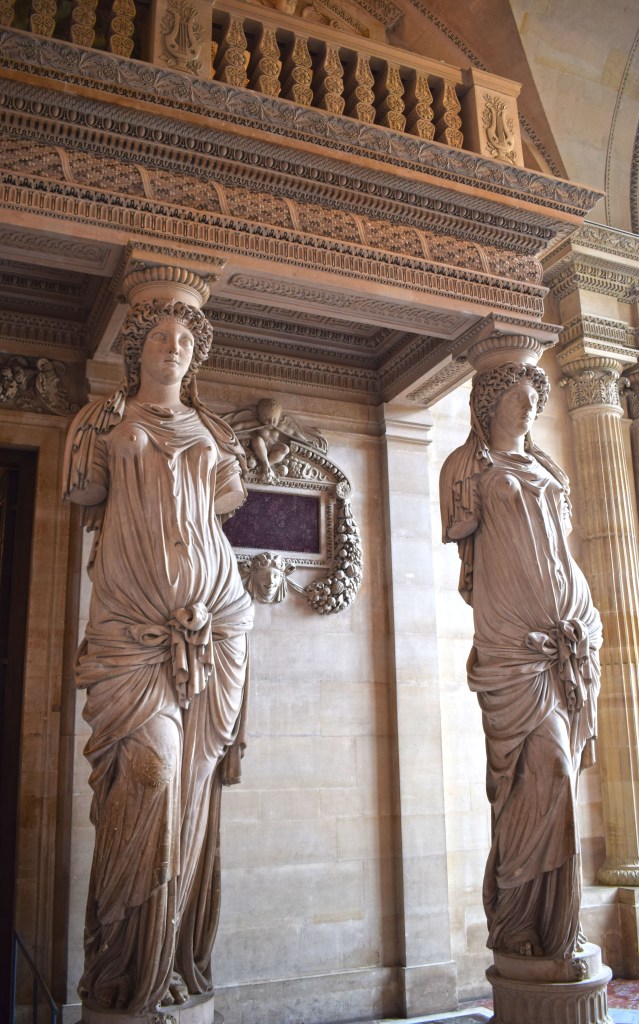
This sculpture of 4 women is the work of Jean Goujon and is modelled upon the ones featured at the Erechtheion, Athens. They feature French 16th century voluptuous grace and style.
6. Walk Through the Room to the far LEFT CORNER to see the Sleeping Hermaphrodite.

This ancient Roman Sculpture was discovered in the Baths of Diocletian. The mattress was sculpted by Gian Lorenzo Bernini. It was originally displayed in the Borghese Gallery in Rome. It was later sold to the French.
7. Walk around the right side of the Fireplace- exit the room
8. Walk through the double red columns you can get a glimpse of the Venus de Milo.
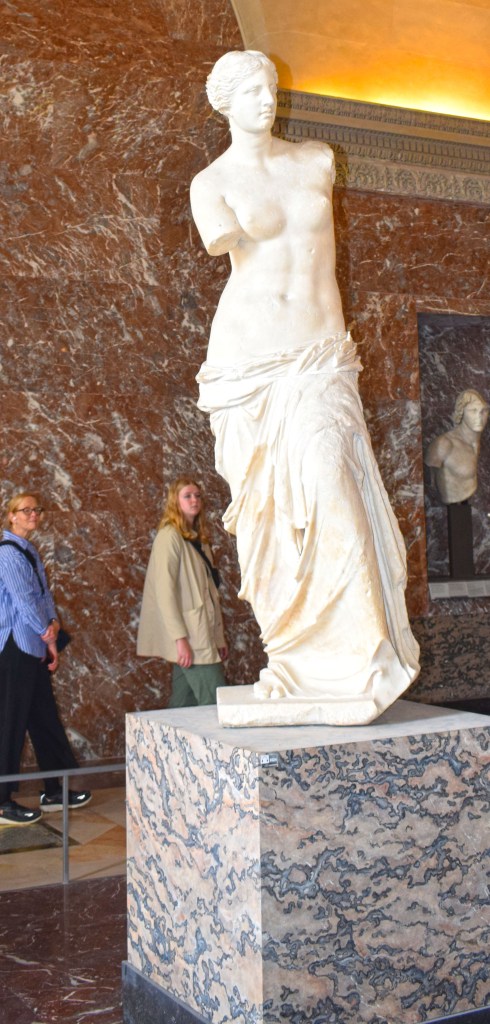
This marble statue takes its name from the Aegean Island (Melos) where it was discovered in 1820. The Louvre claims to have three “great ladies”- the Venus de Milo, The Mona Lisa and the Winged Victory. The statue’s missing arms made identification difficult because arms/hands often featured objects that identified the Greek god. No one really knows who the identity of this lady. She has been thought to be Amphitrite, the queen of the sea as well as Aphrodite, the goddess of beauty, who would have held an apple in her hand.
8. Turn Around and walk through the red pillars
9. After passing the red pillars, turn LEFT
10. Walk to the Rotunda
11. Walk up the stairs. In front of you is the Winged Victory of Samothrace

This is a marble representation of Nike, the Greek Goddess of Victory standing on a ship. It’s proposed date of construction is 190 BCE. When discovered, the statue was shattered into 110 pieces (missing head and arms) and reassembled.
12. Face the statue, turn left
13 Walk up the stairs- enter a round room-704A
14. Walk Through to the Apollo Gallery (705)

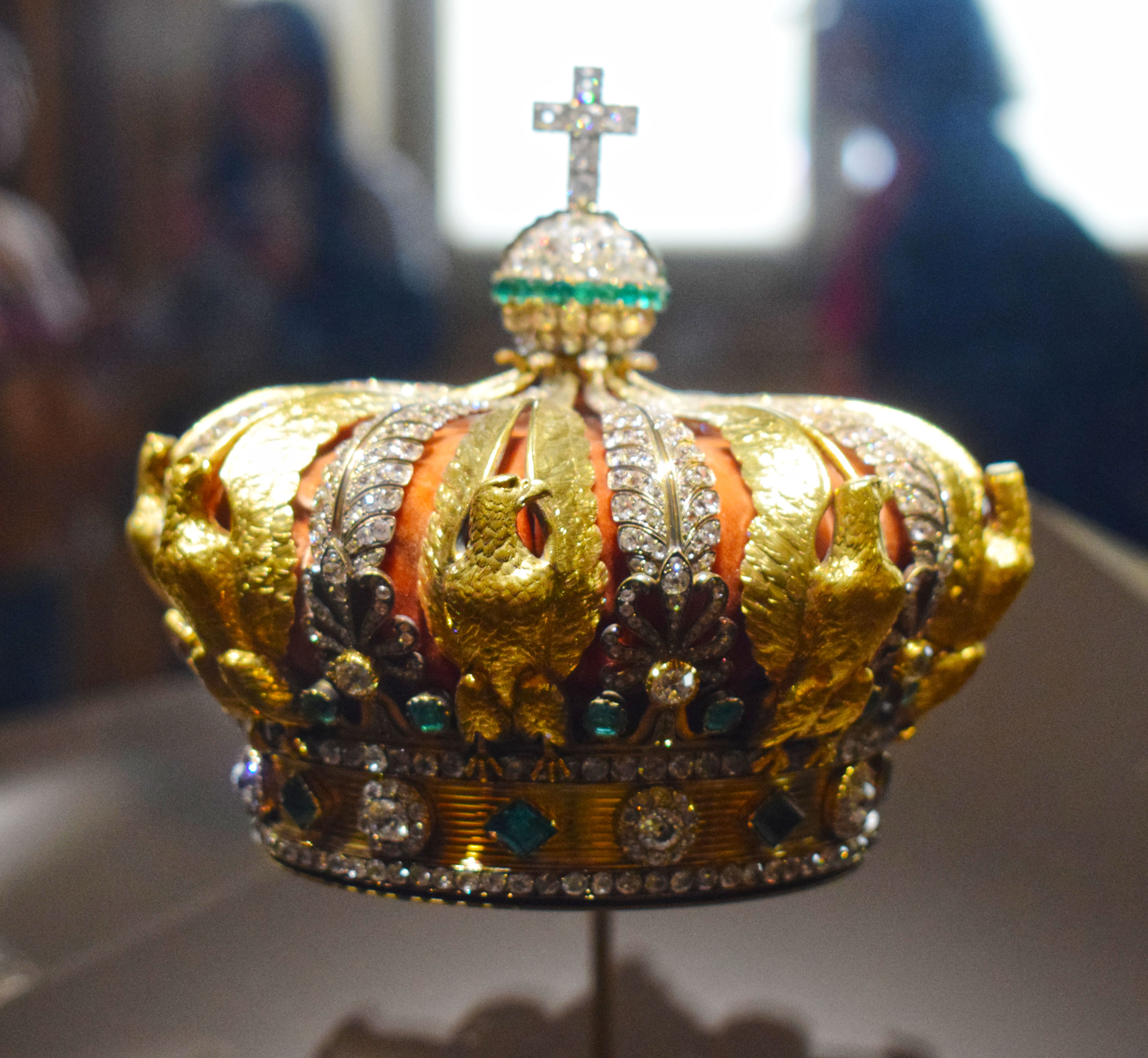


This room was rebuilt by King Louis XIV after it was destroyed by fire. King Louis XIV styled himself as the Sun God and this room reflects this image. He hired painters, gilders, and sculptures to reflect his Sun God image. These same artisans worked on the Hall of Mirrors at Versailles. This room displays some of the crown jewels.
15. Turn right at the end.
16. Enter Room 708 Salon Carre (note: the decorative ceiling)
17. Continue straight into the Grand Galerie.
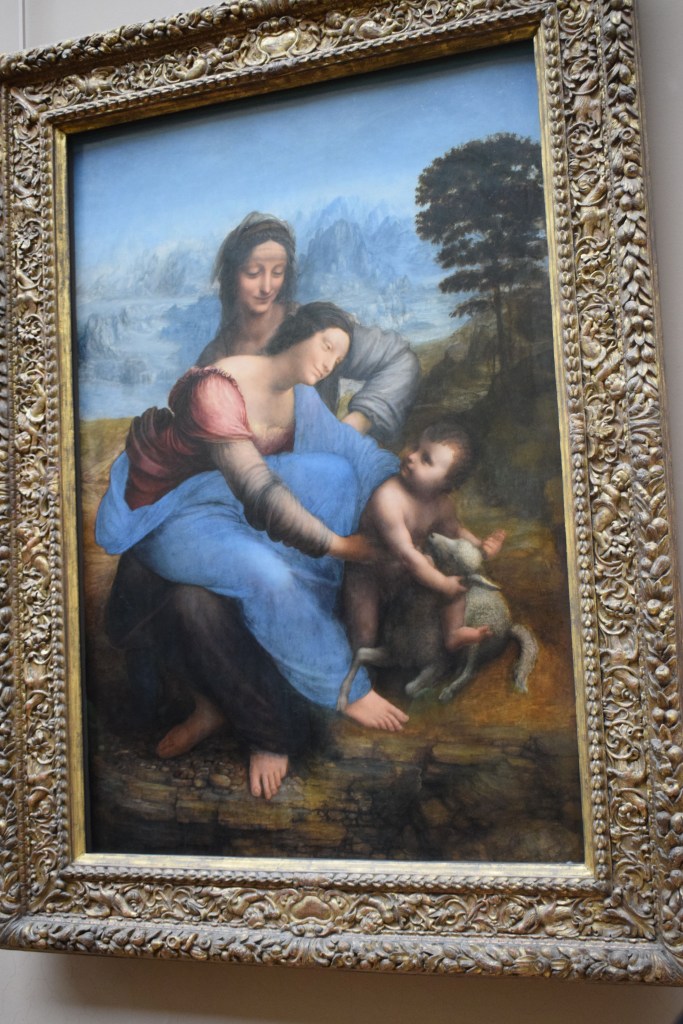
Look for The Virgin and Child with St Anne and a Lamb c. 1508 by Leonard da Vinci features the Virgin Mary seated upon the lap of her mother St. Ann reaching for baby Jesus who is reaching for a lamb. The composition is striking for its use of triangles- the posture of Mary, the hand on hip pose of St. Ann, and Jesus reaching for the Lamb.
18. Walk through the Gallery.
19. Pass the White Columns
20 Turn Right into Room 711
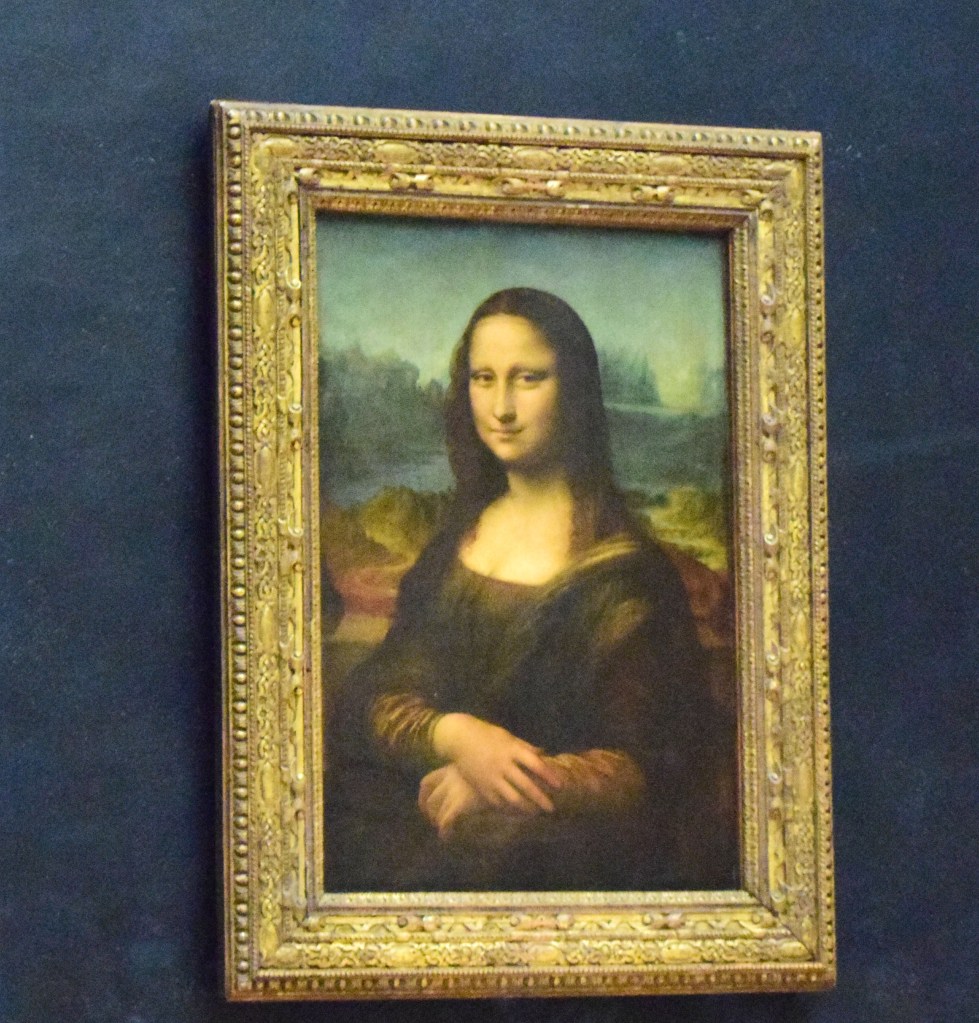
Leonardo da Vinci’s Mona Lisa is world famous and will attract a huge number of visitors on any given day. There really isn’t any semblance of a line- it is largely a work your way to the front of the crowd as others move off. Patience is required- people shoving is never a pleasant situation. The Mona Lisa is kept behind glass, and protected by a roped off area approximately 10 feet from the photo manned by guards. Most people are surprised by the small size of the portrait.
The Mona Lisa is thought to be a portrait of a noble Italian woman Lisa Gherardini, the wife of Francesco del Giocondo. The painting was completed two years before da Vinci’s death. It was acquired in 1518 by King Francois I. This is the only portrait to receive a yearly check up at the restoration and research center underneath the Louvre. The portrait is famous for da Vinci’s use of human anatomy, illusion of depth and softness of edges.
21. Turn around. On the wall opposite the Mona Lisa is the Wedding Feast at Cana

Artist Paolo Veronese created this depiction of Jesus turning the water into wine at the Wedding in Cana in 1562-1563. This portrait measures 22′ 3″ x 32′ 0 (making it the largest in the Louvre) and features 100 figures. Study the picture carefully and you will find incredible details- a parakeet, cat walking through the crowd, and dogs.
22. There is only one exit from the Mona Lisa- take it
23. Enter 701
24. Turn Right to enter 702
25. Go to end- on the left hand side is the Coronation of Napoleon ( Level 1, Room 702, Denon Wing)

Coronation of Napoleon I at Notre Dame de Paris was commissioned by Napoleon and painted by Jacques Louis David in 1804. The painting depicts Napoleon 1 crowning his wife Josephine empress. The painting does not accurately reflect the events of the day. Napoleon’s mother was not present, she is featured in the center.
26. Retrace your steps back to the Gift Shop (Room 701)
27. Go through that room.
28. Enter Room 700- halfway down on the left is the Raft of the Medusa. Also featured- Liberty Leading the People

The Raft of the Medusa was painted by artist Theodore Gericault in 1819 and is considered to be an icon of French Romanticism. The portrait depicts the wreck of the frigate Meduse off the coast of Mauritania on July 2, 1816. On July 5, a hastily constructed raft carried 147 men attempting to find rescue. Only 15 men were alive on day 13 when they were discovered. The men were malnourished, dehydrated and forced to engage in cannibalism. The incident became a huge scandal due to the supposed incompetence of the captain

Liberty Leading the People by Eugene Delacroix portrays the 1830 revolution which toppled King Charles X. A woman, holding a bayonetted musket to represent her passion, determinedly leads people over pile of corpses. She holds a tricolored flag in one hand and wears a Phrygian cap making her the personification of France- also known as Marianne.
29. Go down the large staircase
30. Enter room 403- Michelangelo’s sculpture: The Rebellious Slave and the Dying Slave
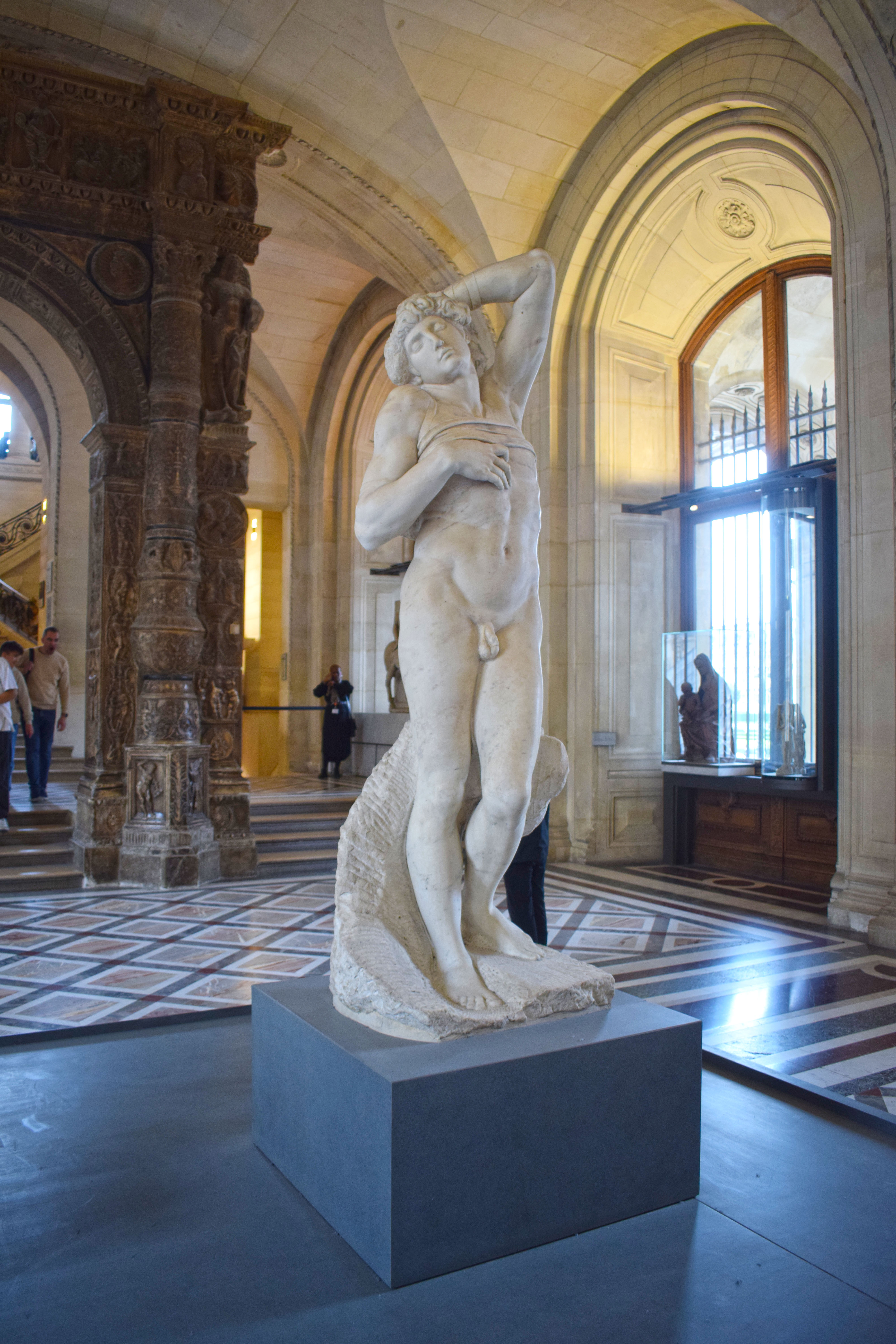

The Slaves by Michelangelo-Sculptures, Room 403, Denon Wing, Level 0
These were commissioned by Pope Jules II for his tomb in St. Peter’s Basilica, Rome, Italy in 1505. They were sculpted between 1513-1515 by Michelangelo. Unfortunately, the works were not finished when Pope Jules passed away. Michelangelo offered the statues to his friend Robert Strozzi who in return gave them to King Francis I. .
31. Walk to end of Room 403 to see Psyche Revived by Cupid’s Kiss

Sculpted by Napoleon favorite artist Antonio Canova, this statue is regarded as a Neoclassical masterpiece and marks the beginning of the Romanticism era. Commissioned in 1787 by Colonel John Campbell portrays the god Cupid awakening the lifeless Psyche with a kiss. The warmth and passion the sculpture communicates to the observer is quite moving.
32. Leave Room 403
33. Walk down the steps to Room 404
34 Walk through until you reach Room 406
35. At the far end, climb a few stairs. NOTE: if you reach the Winged Victory of Samothrace you have gone too far!)
36. Follow the hallway to the left
37. Descend a few stairs
38. Enter Salle de Diane (Room 347) and walk through
39. Enter 345 (yes you were here earlier to see the Venus di Milo)
40. Keep the Venus di Milo to your right.
41. Turn left to enter the Salle de Caryatids (Room 348)
42. Walk through the room and exit Left
43. Descend a few stairs
44. At the bottom make a HARD RIGHT
45. The stone walls signal the start of the Medieval Louvre

These are the original walls of the fortress before it was remodeled into a royal palace.
46. Continue walking until you reach a sign- Sully Medieval
47. Climb the stairs to see the Great Sphinx of Tanis (Room 338)

This granite sculpture was discovered in the temple ruins of Amun-Ra in Tanis, Egypt. Tanis served as Egypt’s capital in the 21-23 Dynasty. The statue is dated much earlier but the exact date is unknown-some date it to the 26th century BCE. The Louvre acquired the piece in 1826.
48. Walk to Room 324 and descend the steps to Crypt d’Osiris
49. Go to the other side of the room and walk up the stairs
50. Walk to Room 320 and go up the stairs which brings you to Level 1 of Sully Wing
51. Enter Room 632- The Royal Residence of Marie Antoinette
52. Follow the royal rooms until you come to escalators in the Richelieu Wing
53. Ready for a break? Walk past the escalators to Terrasse Colbert which offers 2 eateries- one of which is the famous Angelina’s.
Angelina’s –https://musiam-paris.com/fr/restaurants/cafe-angelina/ famous for its hot chocolate and pastries. Its main shop is located on the Rue di Rivoli- but the lines might actually be shorter here at the Louvre. The above link will give you the menu, location, hours, etc.

This link will take you to all the food options available at the Louvre https://www.louvre.fr/en/visit/restaurants-cafes
54. The Apartments of Napoleon III are located next to Angelina’s
55. Go back to the escalators you passed before snack and head down.
56. Walk to Antiquities Orientales
57. Go through Room 236 and into 234
58. Walk up some steps to a landing
59. Turn Left into Room 228
60. Make an immediate Right into Room 229 to the Winged Bulls of Khorsabad

King Sargon II reigned over the Assyrian Empire in the 8th century BCE. In about 713 BCE, he founded Dûr-Sharrukin (the “fortress of Sargon”) in the north of present-day Iraq, a new capital meant to become the largest city in the ancient world. His palace, intended as a symbol of omnipotence, was decorated with benevolent genii called aladlammû (“protective spirit”) or lamassu (“bull-man”). These 28-ton creatures, depicted from the front or the side, were each carved from a single alabaster block. They have the body and ears of a bull, the wings of an eagle, and a human face. Their protective role was questioned when King Sargon II died in battle in 705 BCE. His body was never found, which led some to believe he was cursed; this is why his son and successor, King Sennacherib, decided to move the capital to Nineveh. The unfinished city of Khorsabad was rediscovered in 1843 by Paul Émile Botta, the French vice-consul in Mosul
61. From Room 229 turn right to go to Room 227 for the Code of Hammurabi
It is the longest, best-organized, and best-preserved legal text from the ancient Near East, engraved on a 7.4-foot basalt stele, or pillar, discovered in 1901 at the site of Susa in present-day Iran. The top of the stele features an image of King Hammurabi himself with Shamash, the Babylonian sun god and god of justice. Below this figurative relief are about 4,130 lines of cuneiform text, most of it setting forth a wide range of criminal, family, property, and commercial laws, including the famous lex talionis: the eye-for-an-eye principle.
62. This concludes the tour. Proceed to the exit or wander around for some more fun. To exit- walk back to the escalators and go down one level.
63. Make a U turn at bottom of the escalator and go down some steps
64. Follow the Sortie Signs (Exit) back to the Reception Hall with the inverted pyramid.

Resources:
Map of the Louvre: https://api-www.louvre.fr/sites/default/files/2022-12/LOUVRE_PlanG-2022-EN-.pdf
Interactive Map of the Louvre: https://collections.louvre.fr/en/plan
Books:
The Louvre: The History, The Collections, The Architecture by Genevieve Bresc-Bautier and Gerard Rondeau. https://www.amazon.com/Louvre-History-Collections-Architecture/dp/0847868931
The Pocket Guide of the Louvre by Claude Mignot https://www.thriftbooks.com/w/the-pocket-louvre-a-visitors-guide-to-500-works_claude-mignot/364934/item/4032462/?utm_source=google&utm_medium=cpc&utm_campaign=high_vol_midlist_standard_shopping_customer_acquisition&utm_adgroup=&utm_term=&utm_content=666157863328&gad_source=1&gclid=Cj0KCQjwpvK4BhDUARIsADHt9sQXTJnmVKrWW6q6l12J4DPODQ9Ca2AZ16MvlI2af0A7lsJNVyOG0M8aAhiLEALw_wcB#idiq=4032462&edition=4336880
 Onward Trip