

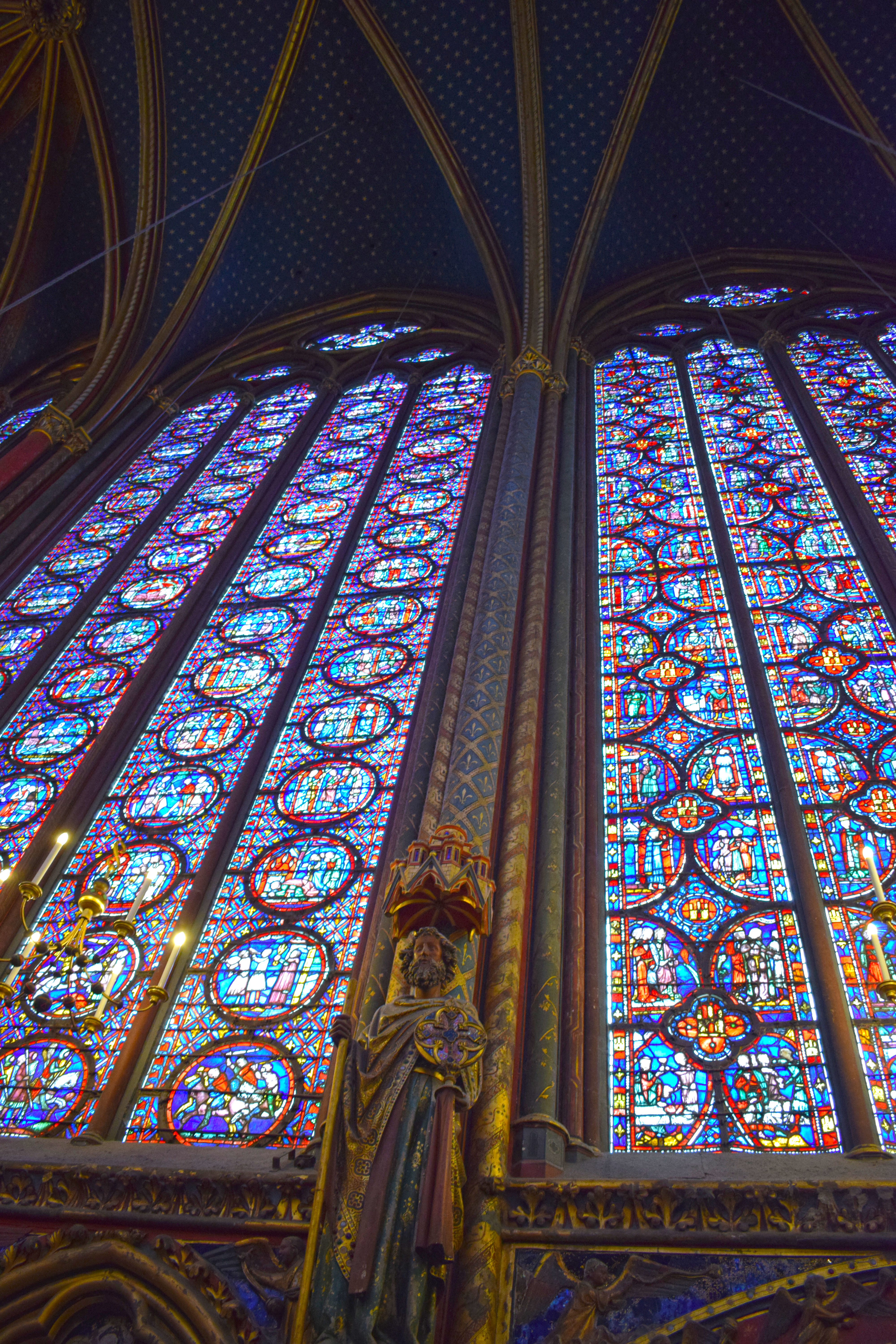
“Evening Concert, Sainte-Chapelle”
The celebrated windows flamed with light
directly pouring north across the Seine;
we rustled into place. Then violins
vaunting Vivaldi’s strident strength, then Brahms,
seemed to suck with their passionate sweetness,
bit by bit, the vigor from the red,
the blazing blue, so that the listening eye
saw suddenly the thick black lines, in shapes
of shield and cross and strut and brace, that held
the holy glowing fantasy together.
The music surged; the glow became a milk,
a whisper to the eye, a glimmer ebbed
until our beating hearts, our violins
were cased in thin but solid sheets of lead.”
― John Updike
- The Basics:
- Entrance:
- The Chapel:
- Background:
- King Louis IX’s Relics-
- Don’t Miss:
- MAPS/DIAGRAMS- UPPER LEVEL
- Review:
The Basics:
Hours: From April 1st to September 30th– 9am – 7pm From October 1st to March 31st -9am – 5pm
Please note : last access to the monument is 30 minutes before closing. Closed on January 1st, May 1st and December 25th
Tickets: https://tickets.monuments-nationaux.fr/fr-FR/familles?site=2035141861660400306 Tickets for Sainte Chapelle are TIMED RESERVATIONS. If you buy a pass that includes Sainte Chappelle- you MUST go to the Sainte Chapelle website and select your time slot. Sainte Chapelle can be bought as a combined ticket with La Conciergerie. The best price and safest way to purchase tickets is to use the above link. There is NO skip the line. Your reservation slot gives you 30 min to enter the site. For example- if you have a 3:30 pm slot- you must enter no later than 4:00 pm. It is advisable to purchase your tickets in advance so that you have a guaranteed visit time- especially during peak seasons.
Location: Sainte Chapelle is within 5-10 min walking distance of Notre Dame de Paris, it is right next door to La Conciergerie and is nearby several bridges crossing the Seine.
By metro / RER
RER B or C: Saint-Michel station
Metro 1, 7, 11, 14: Châtelet station
Metro 4: Cité station
By bus
Lines 21, 24, 27, 38, 58, 81, 85, 96—Vélib’ stations nearby

Entrance:
When you arrive you will be greeted by several line choices. One line is for those who need to purchase a ticket. The line closest to the street is for those holding the current 30 minute reservation. The middle line is for those who have the next 30 minute slot. There is a guard at the entrance who checks your reservation time. He speaks English and is extremely helpful. Once you clear the time slot entrance you will need to proceed to the ticket entrance. Here you show your ticket. Next you move onto the handbag/personal effects screening before you exit into a courtyard. From there you will walk around the back of the chapel to the entrance- just follow the crowd or the signs.
The Chapel:
Is divided into two sections- the Lower and Upper Chapel. The Lower chapel contains the gift shop, and book store. Walk pass these to the stained glass and other features on the lower chapel. When you are ready- take the stairs (these may be crowded) and go up to the second floor- as you emerge from the stairs your mind will be engulfed in a wave of beautiful, colored light. This is one of the drawbacks of the timed ticket- it can not be changed if the weather is cloudy or rainy. Ideally, seeing the chapel in the sun- creates the most stunning visit. The sun lighting is best from 10:30 am- to early afternoon.
Background:
Located on the Ile de Cite, within the Palais de la Cite (home to France’s Kings until the 14th century), this royal chapel reflects the Gothic architectural style and is considered the best example of Rayonnant Gothic style. King Louis IX ordered the chapel’s to be designed as a place to display his passion/holy relics-including the Crown of Thorns. NOTE: The Crown of Thorns was transferred to Notre Dame until 2019 when it was successfully rescued from the fire, held at the Louvre. and returned in a ceremonial procession to Notre Dame December 2024. Subsequently, construction began in 1238 and lasted approximately ten years. The other remarkable relic was the Thorn of the Cross. Pope Innocent IV proclaimed that Christ had ordained Louis IX with his own crown. The Chapel was damaged and most of the collected relics destroyed during the French Revolution, but its magnificent 13th century glass survived.
The Lower level was used by palace courtiers, servants, and soldiers. It measures 36 meters (118 ft) long, 17 meters (56 ft) wide, and 42.5 meters (139 ft) high.
The Upper level housed the treasury of relics and was used exclusively by the Royal family and their guests. It is the same size as the lower level.
King Louis IX’s Relics-
Included over 30 items- the most famous are: Crown of Thorns- worn on Jesus’ head during his crucifixion

Image of Edessa- a square or rectangular cloth that held an image (icon) of Jesus’ face.

Louis IX procured his relics from Constantinople’s Latin Emperor Baldwin II for 135,000 livres (currency of medieval France). The money was then passed onto the Venetians who had pawned the objects. The relics arrived to France in 1239 accompanied by two Dominican friars. Louis IX held a week long celebration. The relics were placed in a silver chest (an additional 100,000 livres). King Louis IX, dressed as a penitent, carrying the chest can be seen in the window Passion of the Relics on the south side of the chapel. The windows were removed during World War II. They were covered with external varnish to protect against scratching from debris during bombing. In 2008 a restoration program began to clean and preserve the glass, remove dirt from the statues and clean the stonework.
Don’t Miss:
- Exterior of the Church– the exterior is rather austere- devoid of flying buttresses, sculpture- very little decoration to hint at the majesty waiting inside. The delineation between the upper and lower levels can be seen in a line of triangular windows which mark the top of the lower chapel.
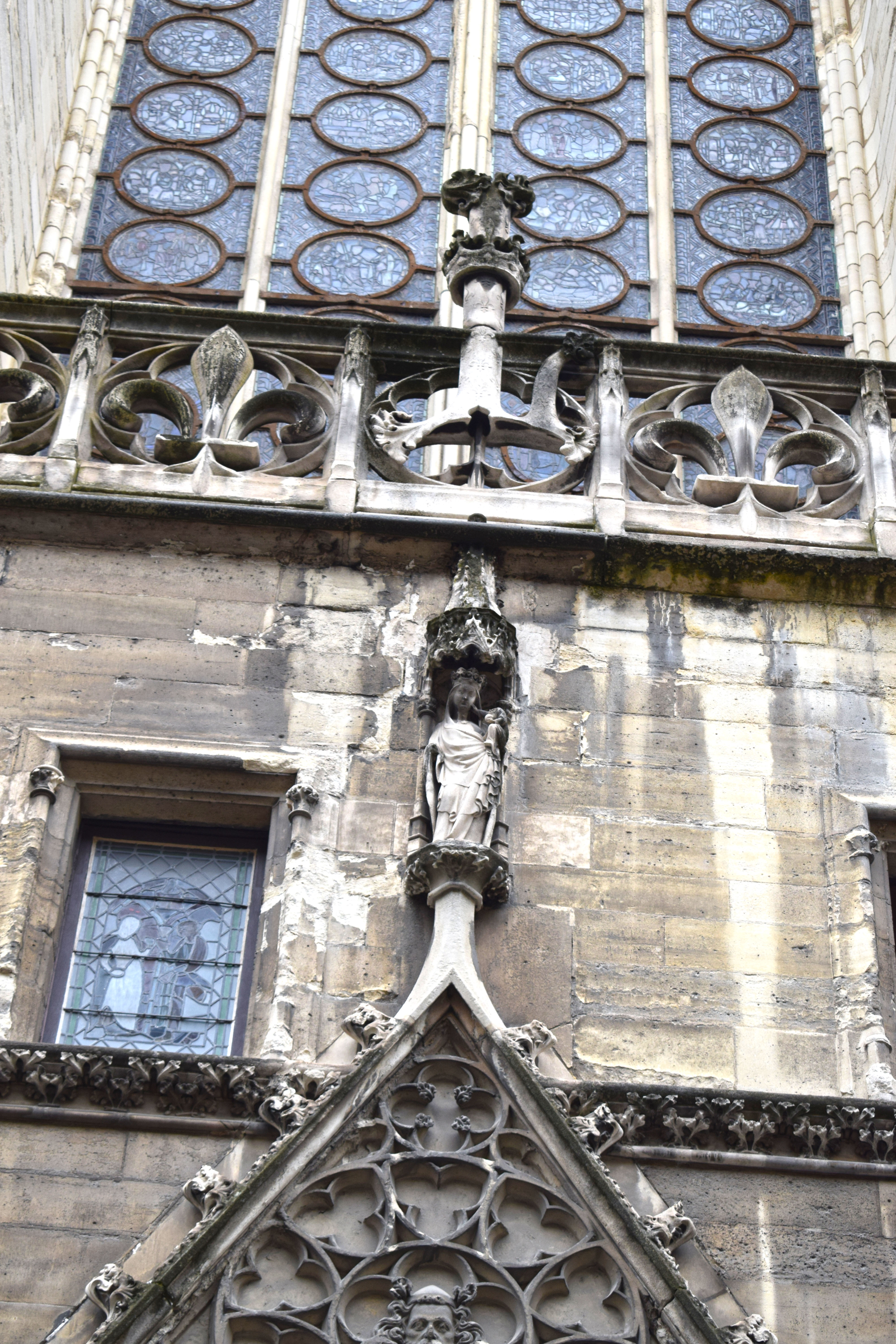


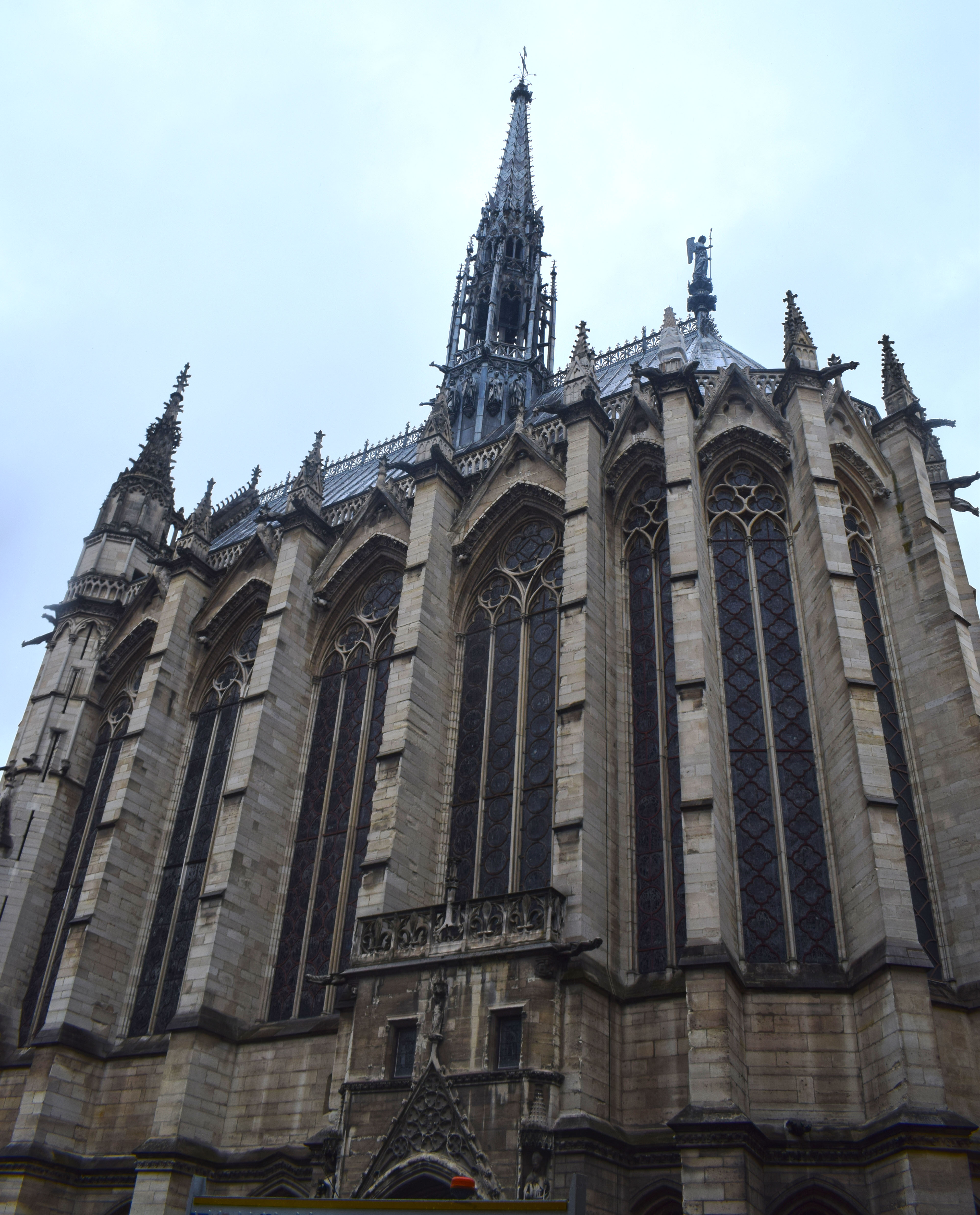
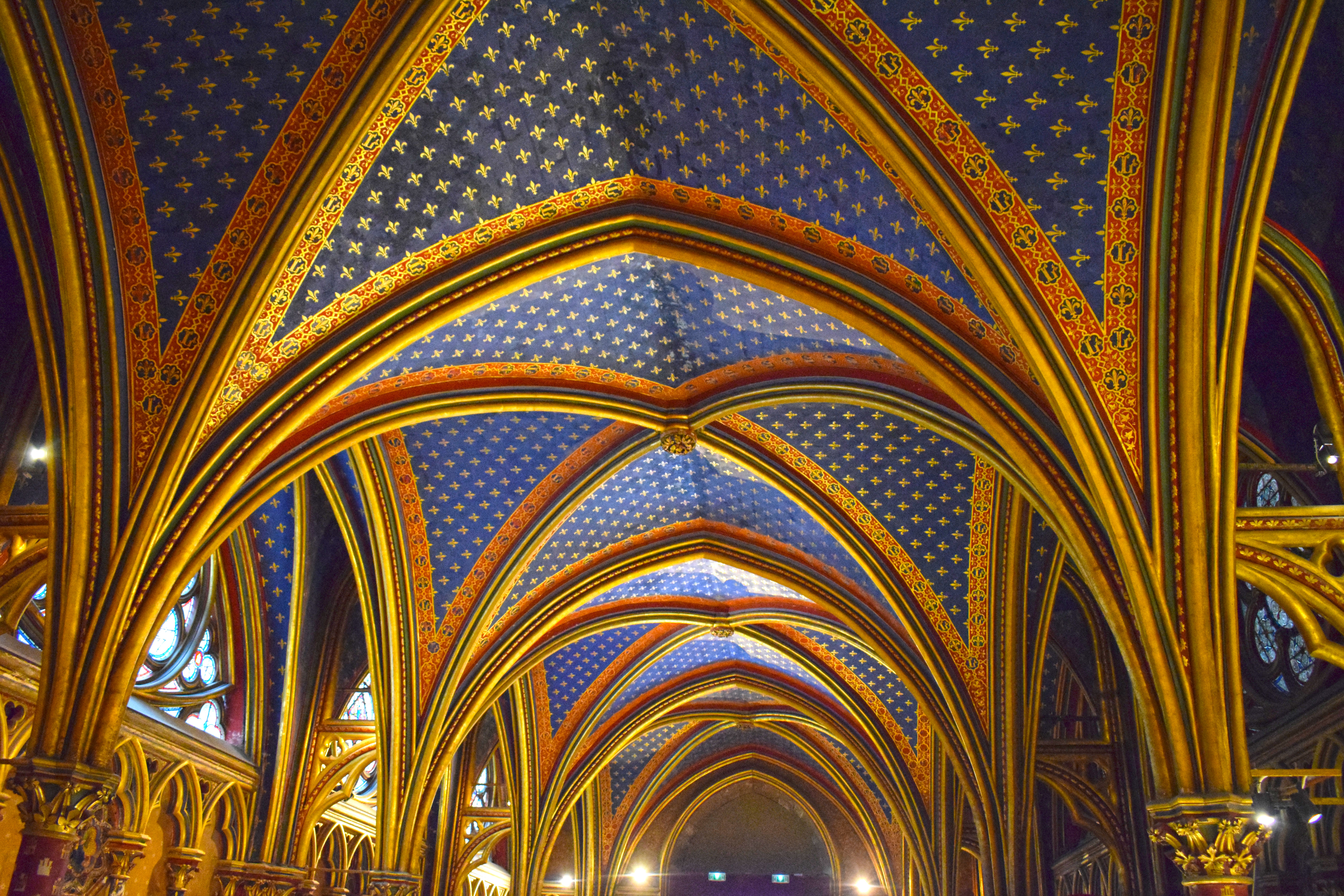
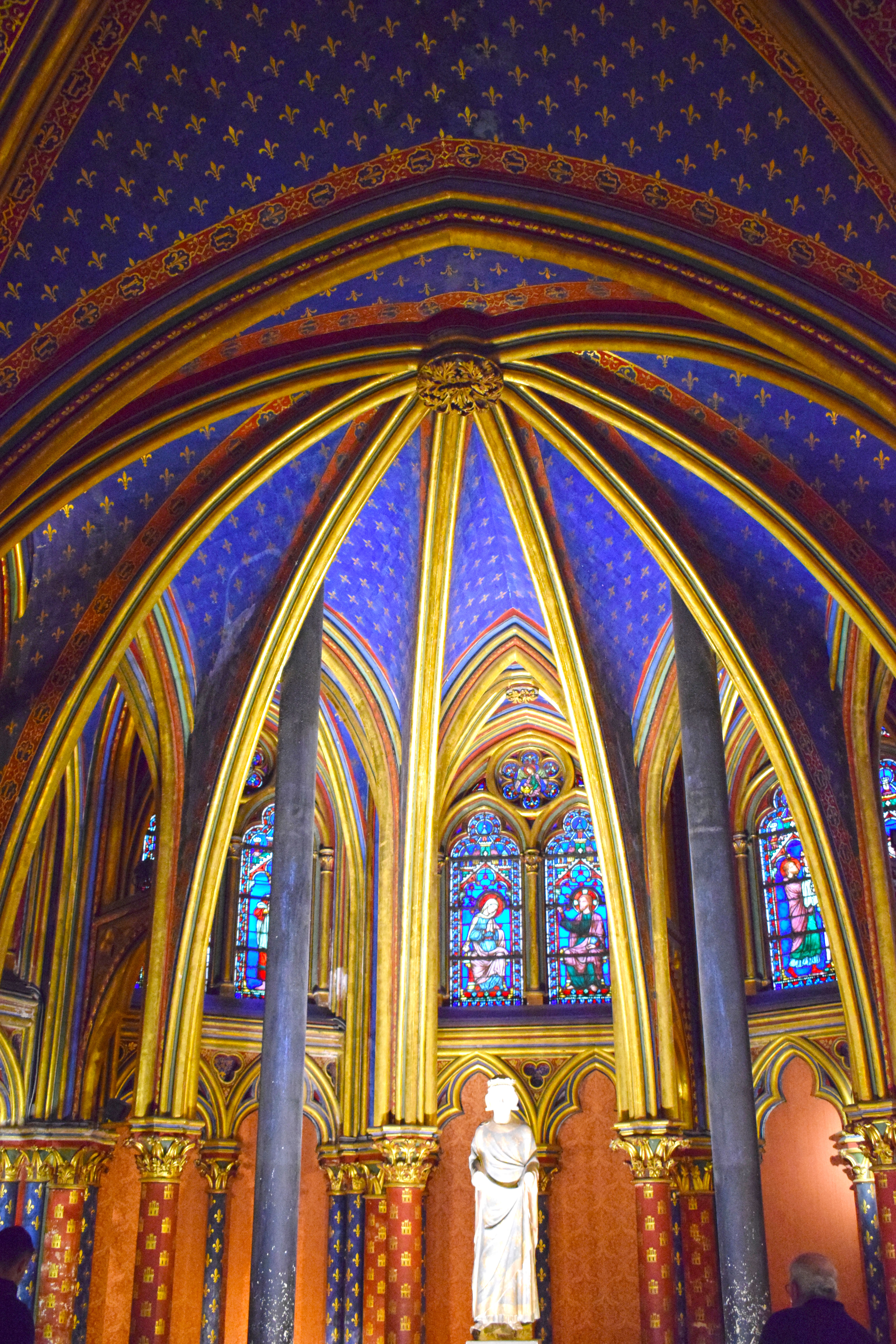
2. The Lower Chapel: is dedicated to the Virgin Mary. Decorative themes focus on the fleur-de-lys emblem of King Louis IX, and a castle from the coat of arms of his mother, Blanche of Castille. The one-hundred forty capitals of the columns are an important decorative feature; they are from the mid-13th century, and predate the columns of the upper chapel. They have floral decoration of acanthus leaves typical of the period. Each of the gilded leaves corresponds with a slender colonette above, which rises upward to support the vaults. The columns are painted with alternating floral designs and the castle emblem of Castile. The red, gold and blue painting dates to the 19th century restoration. The original stained glass of the lower chapel was destroyed by a flood in 1690; it was replaced by colourless glass. The present glass depicts scenes from the life of the Virgin Mary, surrounded by grisaille glass, while the apse has more elaborate and colourful scenes from the Virgin’s life. All the windows were designed by Steinheil during the 19th century restoration. The lower chapel originally had a doorway to the sacristy on the left lateral traverse. Since it could not have a window, it was decorated in the 13th century with a mural of the Annunciation.
Upper Chapel- Reached by a narrow stairway. The structure is simple; a rectangle 33 by 10.7 meters (108 by 35 ft), with four traverses and an apse at the east end with seven bays of windows. The most striking features are the walls, which appear to be almost entirely made of stained glass; a total of 670 square meters (7,200 sq ft) of glass, not counting the rose window at the west end. This was a clever illusion created by the master builder; each vertical support of the windows is composed of seven slender columns, which disguise their full thickness. In addition, the walls and windows are braced on the exterior by two belts of iron chain, one at the mid-level of the bays and the other at the top of the lancets; these are hidden behind the bars holding the stained glass. Additional metal supports are hidden under the eaves of the roof to brace the windows against the wind or other stress. Furthermore, the windows of the nave are slightly higher than the windows in the apse (15.5 meters, 51 ft compared with 13.7 meters, 45 ft), making the chapel appear longer than it actually is. There are two small alcoves set into the walls on the third traverse of the chapel, with archivolts or arches richly decorated above with painting and sculpture of angels. These were the places where the King and Queen worshipped during religious services; the King on the north side, the Queen on the south.
3. 15 Great Stained Windows in the Apse and Nave of Upper Chapel: date from the 13th-15th century. The names of the glass artists are unknown, but the art historian Louis Grodecki identified what appear to be three different ateliers with different styles. The windows in the apse and most of the windows on the north wall of the nave are made by one workshop. These works are known for supple forms and costumes, with simplified features. The second workshop, named by Grodecki as Master of the Ezekiel window, made the Ezekiel and Daniel windows, as well as the window of the Kings. That work is characterized by elongated forms, and more elaborate and angular draperies. The third artist or workshop is called the Master of Judith and Esther, for the distinct style of those windows, as well as the window of Job. They are distinguished by more subtle details in the faces, and a resemblance to the figures in illuminated manuscripts.
The three windows of the eastern apse illustrate the New Testament, featuring scenes of The Passion (centre) with the Infancy of Christ (left) and the Life of John the Evangelist (right).
The windows of the nave are dominated by Old Testament exemplars of ideal kingship/queenship in an obvious nod to their royal patrons. The cycle starts at the western bay of the north wall with scenes from the Book of Genesis (heavily restored). The next ten windows of the nave follow clockwise with scenes from Exodus, Joseph, Numbers/Leviticus, Joshua/Deuteronomy, Judges, (moving to the south wall) Jeremiah/Tobias, Judith/Job, Esther, David and the Book of Kings. The final window, occupying the westernmost bay of the south wall brings this narrative of sacral kingship right up to date with a series of scenes showing the rediscovery of Christ’s relics, the miracles they performed, and their relocation to Paris in the hands of King Louis himself.
The rose window at the west of the upper chapel was made in the late 15th century, later than the other windows. It is a very fine example of the flamboyant Gothic style, named for the flamelike curling designs. It is nine meters in diameter, and is composed of eighty-nine separate panels representing scenes of the Apocalypse. The 15th-century glass artists used a new technique, called silver stain, which allowed them to paint on the glass with enamel paints, and to use fire to fuse the paint onto the glass. This allowed them to modify the color, and create shading and other fine details. It was thoroughly cleaned in 2014–15, giving it greater brightness and clarity

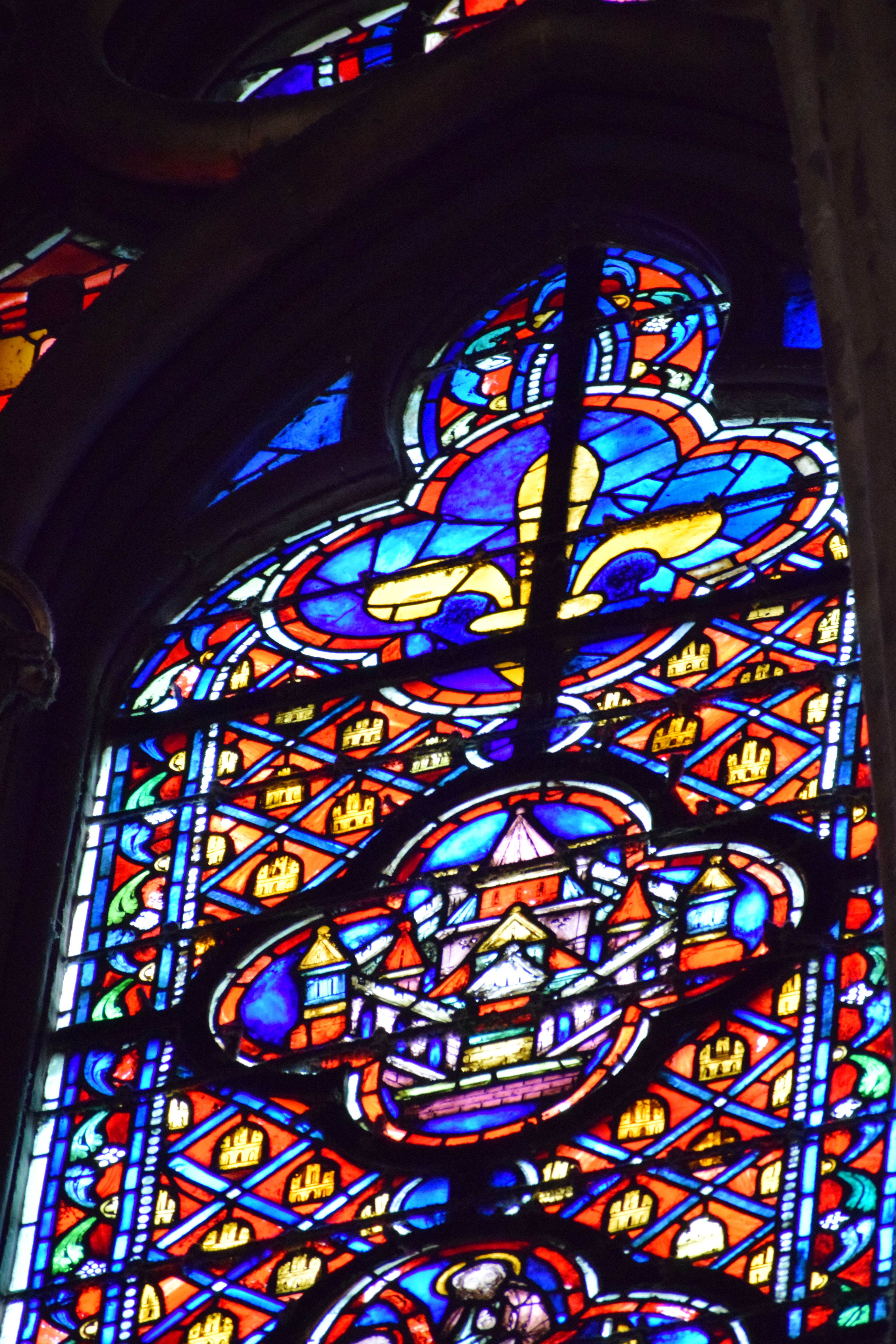


MAPS/DIAGRAMS- UPPER LEVEL

Review:
Sainte Chapelle is a true DO NOT MISS experience- regardless of your religious preferences- you will be enthralled with the multi, deep, vibrant colors emitting from the glass. You will be amazed at how a dank, dark place can become airy and light just through the use of architecture and stained glass. Take some time to study the outside-let the crowd go past you. Enjoy the lower chapel and let the crowds make their way up the stairs- then climb those stairs and experience the mind blowing sensation of being surrounded by stained glass. Bring a pair of binoculars- they really help to pull in the small stories up by the ceiling. Take a moment to find a seat and just ponder.

 Onward Trip