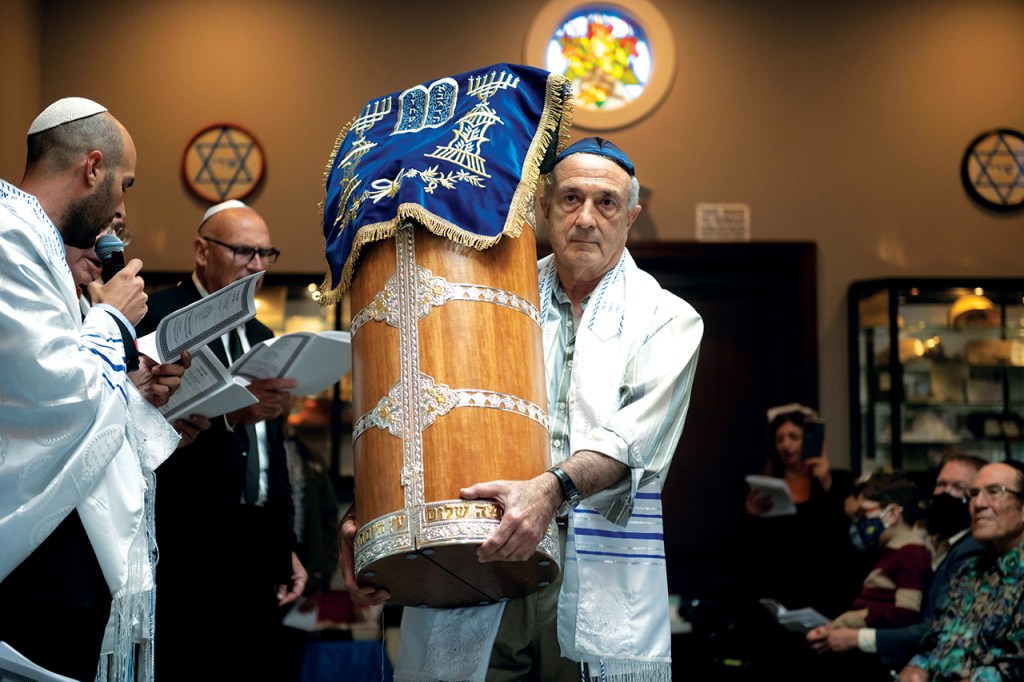
Courtesy of The Jewish News of Northern California
- Tanakh vs. Old Testament
- Talmud and Midrash
- A Challenge to Rabbinic Authority
- Egyptian Karaites
- European Karaites
- Literally Against Literalism
- Other Differences from Rabbinic Judaism
- Discrimination Against Israeli Karaites
- Karaite Discrimination Globally and Hope for the Future
Jewish Virtual Library says: “Karaite Judaism … is a Jewish religious movement characterized by … recognition of the Tanakh alone as its supreme authority in Halakha (Jewish religious law) and theology. It is distinct from … Rabbinic Judaism, which considers the Oral Torah … the Talmud and subsequent works, to be authoritative interpretations of the Torah. Karaites maintain … commandments handed down to Moses by God were recorded in the written Torah without additional Oral Law or explanation. As a result, Karaite Jews do not accept as binding … the Midrash or Talmud”.
Tanakh vs. Old Testament
Opposite popular misinterpretation, the Hebrew Bible and the Christian Old Testament aren’t identical.
Tanakh, a Hebrew name for the Hebrew Bible, is an acronym for its three divisions; these are the Torah, the Nevi’im, and the Ketuvim, “T”, “N”, and “K”. The Hebrew Bible details its version of the events of Ancient Israel and its peoples’ covenant with their deity (Adonai).

Entirety of the Hebrew Bible (Tanakh), scroll format – courtesy of Wikiwand
The Torah, from Hebrew “law” or “instruction”, is the “Five Books of Moses”. As Adonai’s plan for humanity and expression of faithfulness to Jews, the Torah is a basic guideline for Jewish living.
The Nevi’im, from Hebrew “prophets”, is dividable into Former Prophets (Joshua, Judges, Samuel, Kings, etc.) and Latter Prophets (Isaiah, Ezekiel, etc.). Emma Tweitmann of of Alabaster says, “Former Prophets are … historical narratives documenting the time from Moses’ death to the establishment of the nation and kingdom of ancient Israel … Former Prophets interpret the Torah by placing the laws in context … The Latter Prophets tackle a period of turbulence for the kingdom of Israel … This … is further divided into the major and minor prophets … not a statement of their importance or worth … the so-called “major” prophets refer to the longer prophetic books … “minor prophets” … writings are shorter”.
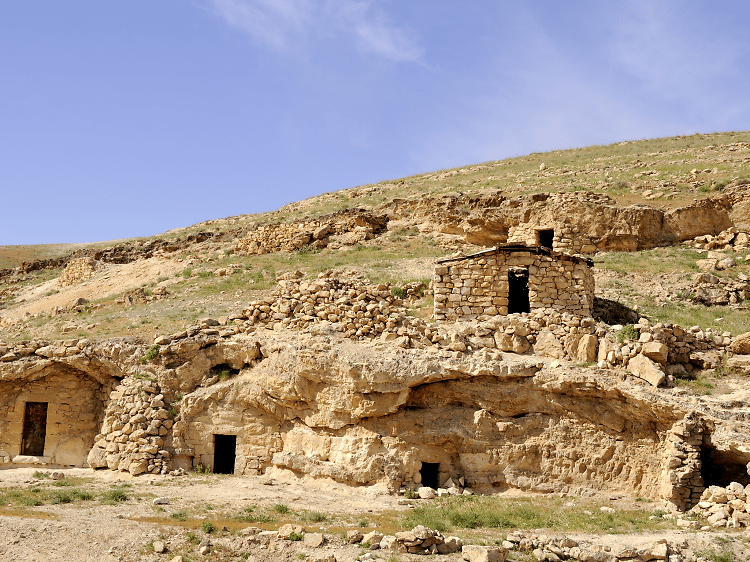
Ancient Israelite buildings – courtesy of TimeOut
The Ketuvim, from Hebrew “writings”, “contains 11 books … from history to poetic verse … The Ketuvim … contains the Megillot scrolls (each of which corresponds to a particular Jewish holiday or festival), the prophecy of Daniel, and the history books of Ezra-Nehemiah and Chronicles. These … focus on events occurring during the Babylonian captivity and exile of the ancient Jewish community, along with their … return home”.
The Christian Old Testament is a companion to the New Testament. It catalogues its interpretation of history from world creation to before Jesus’ birth. Opposite the Hebrew Bible, the Old Testament is 39 books without its Jewish parallel’s division into three segments.
The first five books of the Old Testament are the same as the Torah. Differences exist between Jewish and Christian interpretations of the texts and the chronological order.
Tweitmann says, “The New Testament … sets the Christian Bible apart from the Tanakh … The New Testament is not acknowledged by Judaism, and in contrast, is a large part of the Christian religion. This part of the Christian Bible is said to have occurred after the Old Testament and consists of 27 books such as the Gospels of Matthew, Mark, and Luke. Biblical scholars believe … the New Testament was written … between 50 to 100 A.D. The New Testament focuses mainly on Jesus Christ”.
Jewish tradition claims the Torah was revealed by Moses on Mount Sinai, prophets authored their own books and others attributed to them, and King David and King Solomon wrote many books. Outside Jewish tradition, “Internal contradictions as well as shifts in language and outlook … convinced many modern scholars … the Torah and later historical narratives, as well as the books of the prophets and some of the writings” were authored by multiple people. The same applies to Christian scripture.
Modernly, the Rabbinical view of the Hebrew Bible is, “A biblical narrative does not stand on its own; some contemporary literary theorists of the Bible take their lead from the Midrash and read the Bible as a whole, reading how parts of the Torah reflect on other parts, and how the Prophets and Writings similarly refer to earlier narratives and laws”. Similarities are drawn between Jewish scripture and other Middle Eastern literature; i.e. Noah and the Epic of Gilgamesh and Exodus and Hammurabi’s code.
Talmud and Midrash
The Talmud and Midrash are for Rabbinic Jews the Oral Law to the Hebrew Bible’s Written Law.
Talmud, from Hebrew “study” or “learning”, are ancient teachings that were declared normative among Rabbinic Jews and remain highly regarded by the more religious. The Talmud is the Mishna, Gemara, and additional writings.
The Talmud discusses Rabbinic views of “agriculture, architecture, astrology, astronomy, dream interpretation, ethics, fables, folklore, geography, history, legend, magic, mathematics, medicine, metaphysics, natural sciences, proverbs, theology, and theosophy”. The writing style is reflective of the Talmudic academies the books were written at, debates and arguments about given Hebrew Bible passages aplenty. Names, situations, and ideas brought to discussion “led to the introduction of a story or legend that lightened the mood of a complex argument and carried discussion further”. This is a parallel to Irish monks’ writing of Christian literature and scripture, the monks preserving versions of Pagan Irish mythology by writing it in the margins of what they wrote.

Talmud study – courtesy of Mosaic Magazine
Unbeknownst to those unfamiliar with Judaism, the Talmud exists as distinct editions: “the Palestinian Talmud, sometimes called the Jerusalem Talmud, and the Babylonian Talmud. Both … contain the same Mishnah, but each has its own Gemara. The … Palestinian Talmud [was] written by Palestinian scholars between the 3rd century AD and the beginning of the 5th century … the Babylonian Talmud, by scholars who wrote between the 3rd century and the beginning of the 6th century. The Babylonian Talmud [was] authoritative because the rabbinic academies of Babylonia survived those in Palestine by … centuries”.
The Mishna is “oral laws supplementing scriptural laws”. The Gemara is “elaborations of the Mishna, which in “the Talmud” is reproduced in juxtaposition to the Gemara”. Today, the Talmud “in the precise sense refers … to the materials customarily called Gemara—an Aramaic term prevalent in medieval rabbinic literature that was used by the church censor to replace the term Talmud within the Talmudic discourse in the Basel edition of the Talmud, published 1578–81. This practice continued in all later editions”.
Midrash, “exposition” or “investigation”, is a “biblical interpretation prominent in the Talmudic literature” and a “separate body of commentaries on Scripture” applying the interpretation.
Despite that, and perhaps even because, the Talmud and Midrash were held by Rabbis as “definitive” Tanakh interpretation, critics of these exist to today.
Medieval Jewish mystics dismissed the Talmud as obscuring the Written Law’s meaning more than it clarified, and heretical Messianic Jewish congregations rejected it. Christians opposed the Talmud not just on the basis that it wasn’t part of the Christian canon, it was considered subverting the Christian biblical meaning, preventing Jews from being Christians (another reason for persecution of Jews).
Then, there’s the movement at the heart of this page: Karaites.
A Challenge to Rabbinic Authority
Karaite Judaism is popularly believed to be a creation of the eighth century A.D. Anan ben David, whose motivation for founding was being passed over for an important role at his Jewish community. He may’ve been motivated for practical reasons, but he wasn’t Karaitism’s founder. His branch was the separate Ananism, his contributions later claimed by Karaites, who began by the 9th century A.D.
By then Karaitism was part of many movements rejecting the Talmud and Midrash. Karaites’ name was from Hebrew “People of the Scripture”, referring to their reliance on the Written Law by itself. Karaites considered “rabbinical law … not part of an oral tradition … handed down from [Adonai], nor was it inspired by [Adonai], but … an original work of the sages … [among Karaites] rabbinical teachings are [seen as] subject to the flaws of … document[s] written by mere mortals”.
A rule of Anan ben David’s was “Search scripture well and do not rely upon my opinion”, later a guide for Karaites. This guide translated to Karaites, against many Rabbinites, ensuring Hebrew language study was a religious obligation. Karaites were amongst the first medieval Jews to write Hebrew Bible commentaries. These were ahead of their time by “a figure known as the mudawwin, or author-redactor, who … they believed was responsible for the organization of biblical literary units. Some Karaites claimed Moses as the mudawwin, while others … left room for different answers”. 21st century biblical scholars embody similar systems of study.
Karaites’ strength and signature trait, independent interpretations of the Hebrew Bible, was “a communal liability” by at least the tenth century A.D., since disagreement on interpretations was rife. There was “begrudging acknowledgment” community norms were to “standardize ritual and create unity”. Even so, there was cohesion within Karaite communities as their theology and practices were shaped.
Throughout the 10th and 11th centuries A.D., Karaite communities in the Middle East were protected by their followers who attained positions at Islamic governments. Karaite communities were led by a nasi, “prince”, who claimed lineage going back to the line of the Biblical David.
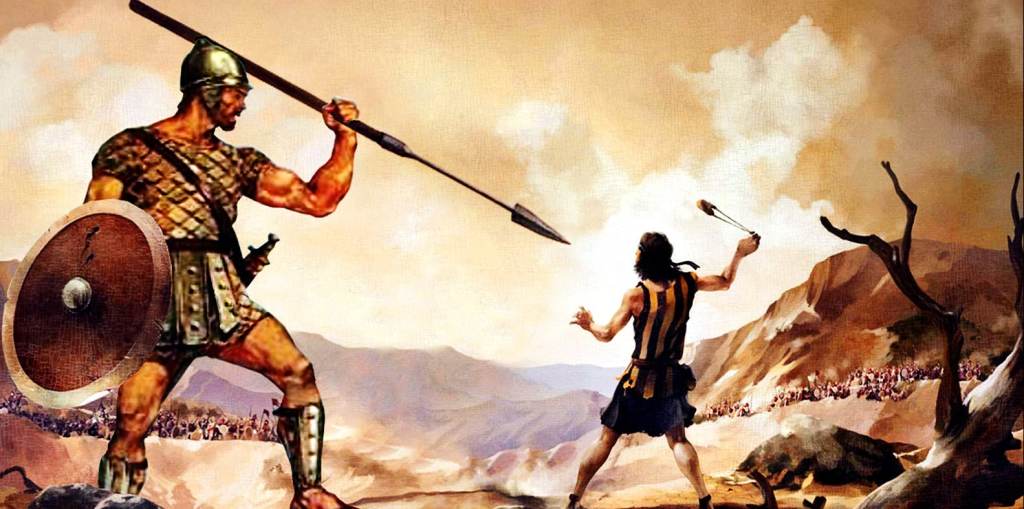
David, an Israelite, fought Goliath, a Philistine; the Philistines, believed to be from Greece, were a people who fought residents of the land of Canaan, though it’s believed over time some Philistines assimilated locally – courtesy of The Tikvah Fund
From the outset, Tanakh only Jews critiqued what were seen as errors in Rabbinic tradition. To bolster their efforts, these Jews familiarized themselves with Rabbinic scriptures and practices. Special criticism was aimed at, among others, Rabbinic academy leaders and their allies.
My Jewish Learning’s Eli Barnavi adds, “The Karaite attack was not powerful enough to demolish the rabbinical citadel but it … succeed[ed] in breaching its walls, for the sect recruited many converts. Towards the end of the eleventh century” Karaitism’s followers were found in Palestine, Egypt, North Africa, Spain, modern Turkey, and beyond. They “considered … dispersion a calamity. Their doctrine … stressed the obligation to live in the Land of Israel. Residing in Jerusalem, praying at its gates, submitting to severe practices of purification … were to hasten the End of Days … without them there was no hope of Redemption. Hence the … propaganda for a Return to Zion … between the ninth and eleventh centuries, the … Karaites [were] the majority … Jewish community in Jerusalem”.
Speaking of Jerusalem, a major reason Karaites are obscure and don’t rival rabbinic numbers are the Crusades. Ben Gurion University’s Moshe Firrouz writes “there was a migration to the Land of Israel of famous Karaite Jewish sages primarily from Persia and Babylon sometime in the 8th and 9th century. They proceeded to develop an important Karaite center in Jerusalem which lasted approximately 150 years until its final destruction, along with the city, at the hands of the First Crusade in 1099 … the Karaite center shifted to Byzantium … a center of Karaite scholarship … [by] the 13th and 14th centuries, the Karaite center moved north”.
Quoth The Jewish Review of Books’ Alan Verskin, says “even as [Rabbanites] and Karaites disagreed on theological fundamentals, they identified themselves and their opponents as … a single religious community. For centuries, [they] read and responded to one another’s works, developing … scholarship in tandem … they … mingled, shared religious ceremonies, depended on one another’s charity … intermarried … saw one another as brethren”.
There were, in the same vein of other interfaith troubles (i.e. Eastern Orthodoxy and Protestantism vs. Roman Catholicism and Ahmadiyya vs. other Islamic sects), many instances where this wasn’t the case. I.e. Moses Maimonides, who was a renown Sephardi religious commentator, advocated “a rabbinic court could execute Karaites as heretics”. After he climbed the ranks of his community, he alleviated his stance somewhat, though his views on Karaites continued to be unflattering (perhaps due to them being outside rabbinic doctrine). Even when Karaites “were not discriminated against, as a minority, [there was] … social pressure to conform to majority practices”.
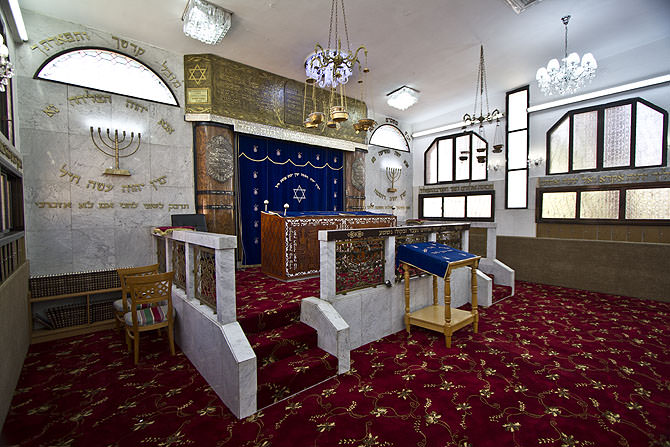
Karaite Synagogue, Ramla, Israel – courtesy of Tours in Ramla
Karaites, long ago possibly 40% of the world’s Jewish population, transformed into the oldest surviving Jewish movement outside rabbinic denominations. As of the 2020s, Karaites are 50,000 of the globe’s over 15 million Jews.
Due to rejecting non-foundational scripture, Karaitism is misconstrued as the Jewish equivalent to Protestantism. A Blue Thread, detailing a rabbi who made this same implication, says, “In doing so, he completely ignores the theological perspective of Karaite Judaism. At its core, Karaite Judaism believes … in biblical times … Israel was led by prophets and divinely sanctioned priests and judges … who … helped clarify and uphold the Law. Today … no prophets … no divinely sanctioned priests and judges … we are all responsible to search the Scripture … and determine the meaning of the commandments. We should not … delegat[e] that responsibility to any non-divinely sanctioned leader”.
Egyptian Karaites
Egypt’s Karaite community lived in Cairo for over 1,000 years. They “were integrated into Cairo’s ethnic division of labor … working as goldsmiths and jewelers. Remnants of their historic role persist[ed] in the Karaite family names of firms in Cairo’s gold market, like al-Sirgani, though no Karaites remain in the trade and few Egyptians are aware of the origin of these names. In the twentieth century, wealthier Karaites … move[d] to the middle-class districts of ‘Abbasiyya and Heliopolis and [acquired] elements of bourgeois, Franco-phone, cosmopolitan culture. But in all respects except religious practice, the daily lives of the Karaites … were indistinguishable from those of their Muslim neighbors”.
In March 1901 “the Karaite communal council was organized and recognized by the Egyptian state … The editor of the community newspaper explained, “Our community’s existence is based on religion so it is our first duty to preserve our religion and … behave in accord with the law of … Moses””.
By the 1940s, “most Karaites … only partially assimilated the secular-liberal notions of citizenship and nationality recently introduced to Egypt. They saw themselves as a protected religious minority in a Muslim country, employed concepts and institutions derived from the Islamic cultural and political tradition, and regarded themselves as Egyptian in those terms”.
The Egyptian Karaite communal language “was Arabic … Karaite dialect [was] indistinguishable from those of other Cairenes. Even in referring to contested localities [where] Jews and Arabs used different names … Arabic [was utilized in place of] Hebrew terms—“Nablus” (Shkhem), “al-Quds al-sharif” (Jerusalem), and “Filastin” (the land of Israel). Because the Karaites spoke native Arabic … they were fully integrated into Arabo-Egyptian culture”.
Most Karaites “were entitled to be and wanted to be Egyptian citizens, but they met with … resistance”. Some Egyptian Karaites attained “French or Russian citizenship even though they and their fathers … never left the country … because citizenship used to be sold, and a Karaite … bought it” despite being Egyptian culturally and nationally. It implies “even Jews who regarded themselves as fully Egyptian and … eschewed political Zionism were not treated exactly like other Egyptians”.
Many Karaites stayed in Egypt until the 1960s, their immersive Arabization permitting them to stay longer than the Rabbinic community. Ultimately, however, they weren’t able to push back against the intensifying Arab world hostility towards Jews following Israel’s 1948 re-foundation.
European Karaites
Outside the Middle East, Karaitism formed roots in places like Ukraine’s Crimea region.
Tsarist Russian law differentiated Karaites, noticeably Crimean Karaites, from other Jews. By 1863, Karaites were, by the Russian legal system’s definition, equivalent to Christians rights-wise. In response to anti Judaism across Russia, Crimean Karaites, who spoke a Turkic language, strove to distance themselves from Rabbinic Jews and even Judaism itself. Turkic culture was emphasized more than their Jewishness.
The National Socialist rise to power led Berlin’s Karaite community to campaign for exemption from the Nuremberg Laws. They based their request on the Tsarist Russia’s designation of Karaites as non Jews. The Nazi government agreed to comply, though its designation of Karaites as non Jews was inconsistently applied wherever Germans invaded. Being a Karaite was no guarantee Germans wouldn’t kill a person, since their culture was unmistakably Jewish.
Literally Against Literalism
Karaites’ fall to obscurity and shriveled congregation sizes lead to inaccurate views from outside the movement. Karaites are seen as interpreting scripture literally, similar to Christian Evangelicals and Southern Baptists, and “only follow what the Torah says and do not search for the deeper meaning”.
A Blue Thread, a Karaite blog, says, “Karaites do not follow what the Torah “says;” we … follow what the Torah “means”” and describes the movement’s non-literalism by three samplings.
Concerning forbidden marriages per Leviticus 18, “The Torah literally tells us that a man is not allowed to have relations with his aunt. (Leviticus 18:12.) … Karaites also forbid relations between a woman and her uncle (because we see no principled reason to differentiate the two situations). In contrast, the Rabbinic tradition considers it a big mitzvah for a man to marry his niece”.
Another: “the Torah literally commands us not to kill a bull or ram and its child on the same day. Although the verse refers to male animals, Karaites … forbid the killing of a female animal and its child on the same day … the historical Karaite view (unlike the Rabbinic view) is to forbid slaughtering a pregnant animal, even though the Torah does not even mention female animals (let alone pregnant females [sic] animals) in this verse”.
A Karaite distinction from Rabbinism is the former’s refusal to wear tefillin, or boxes containing commandments, during prayer: “The Torah literally commands us to “tie” the commandments as a sign upon our hand. (Deut. 6:8.) But the Hebrew word for “tie” very often has a metaphorical meaning. For example, we learn that Joseph’s soul is “tied up” (from the same Hebrew word) with Benjamin’s soul”.
Other Differences from Rabbinic Judaism
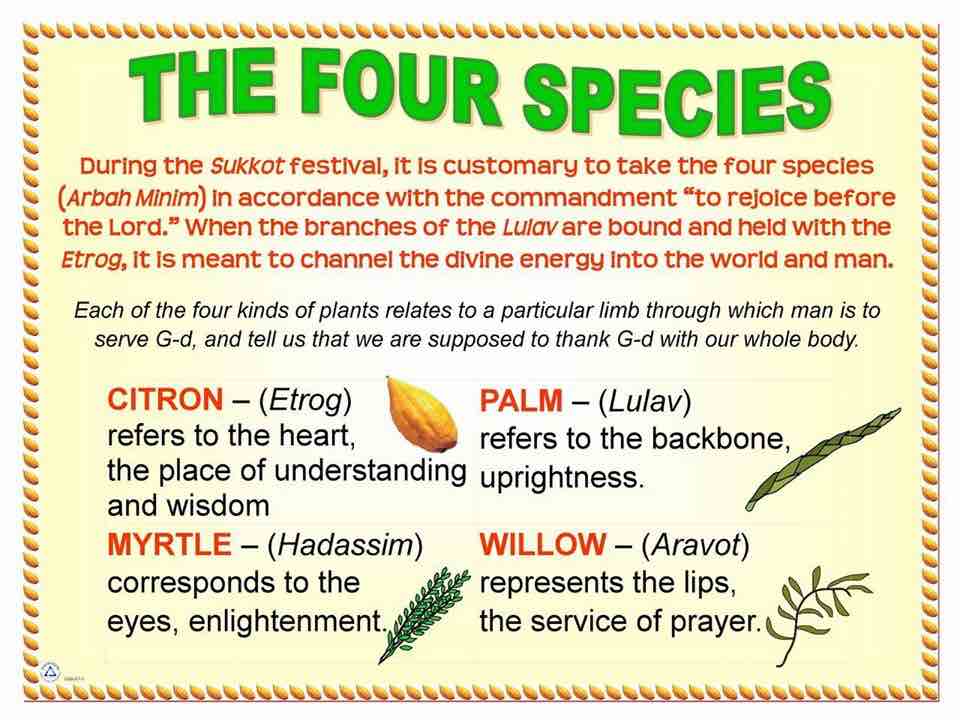
Barnavi says, “Some of the Karaite doctrines and customs distinguishing them from the Rabbanites are … interpretation of the biblical rules concerning the observance of the Sabbath, celebrating the festivals differently (they do not blow the shofar on Rosh ha-Shanahnor [sic] do they wave the “four species” on Sukkot; and they ignore Hanukkah since it is not mentioned in the Bible) … Their liturgy is mostly biblical psalmody, and they practice different methods of ritual slaughter … widen[ing] the rift between them and the Rabbanites, as they cannot share the same food”.
Courtesy of United Israel

Samaritans, an ethnoreligious people related to Jews, celebrate similarly, including Sukkot; pictured is a Samaritan approach to etrog, or citrus fruits – courtesy of The Librarians
Uri Shapira of i24 News says, that on Shabbat [day of rest, Saturday for Judaism], “[Karaites, or at least those most stringent about adherence] don’t use any electronic or mechanical device and even turn off their fridge, something even … Ultra-Orthodox [Rabbinic Jews] don’t do”.
Shapira quotes Oshra Gezer, vice-chair of the Universal Karaite Judaism organization: “If we talk about weddings, we have to talk about gender equality … All our wedding vows are written in Hebrew, and it is … an equal agreement between a man and a woman … the same rights … if, from any reason, the agreement is not fulfilled, they can both, man or a woman … ask for divorce. There is no ‘Agunot,’ [women who, for various reasons, are stuck in a religious marriage]”.
Quoting Gezer again, “there is no separation between men and women. Karaites believe … women and men … pray together … We take off our shoes because it’s a holy place”. With no Jewish temple standing, Karaites “treat [the] synagogue as [the] temple”. The “no separation” claim isn’t accurate as, even with the less strict dress codes for women and a more egalitarian attitude to female worship contributions (compared to traditionalist Rabbinic Judaism and in particular Orthodox Judaism), people continue to be segregated by gender in many Karaite synagogues.
Gezer addresses observations of Karaite prostration, opined to be similar to Muslim worship: “”When people see how we pray, it looks like a mosque. But it’s … easy to explain … Judaism is a monotheistic religion. As are Christianity and Islam … we … maintain the way we should pray, like how we are obligated to pray. We are not afraid of being compared to other religions”. Karaitism kept Middle Eastern Jewish worship cornerstones later adapted by faiths such as Islam, i.e. prostration.
A Blue Thread explains, “[we] derive our laws from the entire Tanakh … the Karaite community of Egypt maintained the Cairo Codex of the Prophets – which shows … Karaite … affinity for text beyond the Torah [opposed to the idea Karaites read little outside the Torah]”. Against the idea Karaites “reject post-Torah rabbinic interpretations, additions and customs, and … theological ideas such as Resurrection and Life after Death that are not explicit in the Torah”, belief in Resurrection of the Dead is a Karaite belief since the 12th century A.D., Karaite sage Yehudah Hadassi declaring it a principle of faith.
Another wrong conclusion about Karaitism, again per A Blue Thread, is ““What makes [Karaites] popular with Reform communities is … they accepted patrilineal lineal descent as the definition of Jewish identity”, never mind that many Jews (including Reform) scarcely know Karaitism still exists. To clarify, “Regardless of affiliation, the overwhelming weight of biblical evidence is … Jewish (or “Israelite”, to be more precise) status is patrilineal … the difference between Karaites and … the Reform Movement, is … Reform … accepts Jewish identity through patrilineal or matrilineal descent. The general Karaite view is … it is only patrilineal descent that matters”. This is evidence Karaitism’s gender roles paradigm requires a reform if equality is to be achieved and women are to contribute more to it (to be fair, this isn’t unique to Karaitism, faiths like Orthodox Judaism and Roman Catholicism struggle to modernize too).
Pertaining to Karaite celebration of Purim but not Hanukkah, Hanukkah isn’t in the Tanakh but Purim is. In Karaites’ case “most … do not believe Purim to be a “required” holiday. Unlike [Rabbinic Jews], [no] Karaite … mitzvoth [are] attached to Purim … Purim is simply a custom ingrained in … Jewish fabric”.
Moving on, “Simchat Torah (“The Rejoicing of the Torah”) … celebrates the conclusion of [the] annual cycle of Torah readings … a relatively recent Jewish holiday, even in the Rabbinic tradition … [many Karaites don’t believe] it is forbidden … to follow customs … that otherwise do not violate the Torah … Karaites object to turning customs into commandments and placing greater importance on … customs”.
Discrimination Against Israeli Karaites
The modern state of Israel, theoretically a place where Jews the world over can congregate and live peacefully, has seen many issues throughout its existence. One of these is Karaites’ standing.
In 2013, newspaper The Economist said “rabbis working for Israel’s ministry of religion deemed Karaite marriages invalid, fined their butchers for claiming to be kosher, and demanded that Karaites marrying Orthodox Jewish women should convert, sometimes having to undergo tavila, or baptism”.
According to newspaper Haaretz, Orthodox Israelis are given preferential financial treatment over Karaites, some observers believing Karaites are disadvantaged to prevent their population from growing and attaining prestige in Israeli society. It’s possible to interpret this as from Israeli elites who are biased towards Orthodoxy, seeing Talmudic and Midrashic Judaism as the only “real” form of Judaism, and fearing less adherence to these would mean a “less authentic” Judaism would emerge.
In 2016, A Blue Thread noted, “the State of Israel recently designated certain areas of prayer at the Wall for Reform and Conservative Jews, but many in the Orthodox community are not too pleased”. Orthodox Jews commonly express dissatisfaction with their fellow Rabbanites by “making fun of Karaites”.
ABT says “an often repeated joke … Karaites stole Moses’s shoes … the gist is … a Karaite and Rabbanite … stand … before a king and are about to debate which form of Judaism is more proper. The king asked the Rabbanite why he was clutching his shoes tightly (rather than leaving his shoes behind in the palace like all the other Jews). The Rabbanite responds that, when God told Moses to remove his shoes at the burning bush, a Karaite stole Moses’s shoes. Since then, the Rabbanite explains, “whenever we are in the presence of Karaites, we make sure to hold on to our shoes.” Wanting to defend himself, the Karaite says … this is absurd … everyone knows there were no Karaites back then. And with that, the Rabbanite rested his case”.
ABT continues, “the joke suggests … we should not listen to dissenting religious opinions … For the past 500 years, the Karaite voices [were] so silent that Orthodox Rabbanites only rarely mention … we exist, and when they do, it is often to deny us the opportunity to make our case”.
Karaite Discrimination Globally and Hope for the Future
ABT laments “Karaites remain on the fringe, a mere after thought in the Jewish landscape. The normative form of Judaism today is Rabbinic Judaism – so much so that when someone contemplates his or her Jewish identity, they first think Orthodox, Conservative, or Reform (or maybe Ashkenazi, Sefardi, or Mizrahi) … he or she never even has to come to terms with the fact … their form of Judaism is operating within the Rabbinic Jewish framework”.
Karaites are a “minority of a minority” just like Sephardi Jews and Mizrahi Jews.
The University of San Francisco’s Professor Aaron J. Hahn-Tapper wrote about Karaitism in one of his books. He “places Karaites in the section called “Borders” … and … challenges … readers to ponder whether a group who does not accept Rabbinic Authority can be Jewish”.
ABT responds, “Why are Karaites on the border? We believe in God, we accept the entire Tanakh. Why isn’t the reform movement on the border? Many Reform Jews do not believe in God. Why isn’t reconstructionist on the border? Many Reconstructionist Jews place contemporary norms over biblical norms”. ABT adds to the remark, “I have no … animosity toward any of these Jewish movements. And I am not challenging their beliefs. I just raise the example to re-orient people’s frame of reference”.
However, “These other movements still operate within a Rabbinic paradigm – even if they do not truly accept rabbinic authority”.
ABT calls to mind an incident from over 1,000 years ago involving Karaite sage Jacob al-Qirqisani. al-Qirqisani interrogated Rabbanites about their mingling with Issawites instead of Karaites; it puzzled him since Issawites were messianic, and messianism is frowned upon in mainstream Judaism. The response he got was the Issawites agreed with Rabbanites about festivals.
An interpretation of the response is “Rabbanites … regard open apostasy [i.e., the Issawite adherence to a messianic leader] more favorably than disagreement [by the Karaites] over a festival of [the Rabbanites’] own invention.”
Even though Karaitism boomed, Rabbanites would’ve interacted with messianic Jews who stuck to the same festivals instead of Jews who looked strictly to the Tanakh.
ABT, deriving from Hahn-Tapper, offers a way of thinking to push back against discrimination against Karaites and other minority sects: there’s no single Judaism, there’s multiple Judaisms.

Courtesy of Haaretz
ABT even says this phenomenon is ongoing: “many of these historical divisions *are* a thing of the past”. ABT points out that he’s been in contact with the Orthodox community, and it can be inferred there shall be more of these “almost unheard of” interactions in the future.
There’s also concerns about Karaitism’s adherents, given it’s little against Rabbinic Judaism.
Gratz College’s Susan Elkodsi says “Like Rabbinic Jews, Karaites … never actively [went to get] converts … out of fear of persecution or … to maintain a more homogenous community … or a lack of desire to proselytize … [from the outset] there was … movement in and out of the Israelite/Jewish community, [yet] beginning in Talmudic times the prevailing attitude was to discourage proselytizing, since in both Christian- and Moslem-ruled countries, converting to Judaism was illegal and posed a danger … for the convert [and] the entire Jewish community … the Karaites … were … insular … afraid of foreign influence”.
For the miniscule size of Karaitism currently, the sect’s stance against conversion to it is lessening.
Elkodsi says, “In the face of rising rates of intermarriage between Karaite and Rabbanite Jews, as well as interfaith marriages, the conversion of non-Jews into the Karaite community and the adoption of Karaite customs, beliefs and teachings by Rabbanite Jews” keep the movement afloat.
The Jewish News of Northern California points out, in a piece discussing Karaitism with sage Moshe ben Yosef Firrouz, “Firrouz was in the [Francisco] Bay Area [in 2015] to officiate at a group conversion, which has taken place at the Daly City synagogue every other year since 2007. Fourteen individuals were welcomed … to Karaism on Aug. 3, from Kansas, Brazil, Mexico, Puerto Rico, the Dominican Republic and Israel. It was the culmination of a … study course organized by the Jewish Karaite University … J. wrote about the first mass ceremony in Daly City eight years ago, described to us as the first Karaite conversions in the world since 1465. More than 50 converts … joined the community since then”.
In Israel itself, there are Jews who are disillusioned with the Chief Rabbinate’s decisions concerning Jewish customs and look directly to the Tanakh for guidance in place of the Talmud and Midrash.
Karaitism is likewise gaining ground due to: Jews who want a more direct interpretation of the Tanakh instead of those filtered through Talmudic and Midrashic authors; the internet making Karaitism’s existence more well known and the faith itself easier to connect to globally; and Karaite techniques themselves emphasizing personal study and egalitarianism pertaining to religious practice.
References:
- “Karaites”. Jewish Virtual Library. https://www.jewishvirtuallibrary.org/karaites
- Tweitmann, Emma. “The Tanakh Explained: The Hebrew Bible vs. The Christian Bible”. Alabaster. 7 July 2021. https://alabasterco.com/blogs/education/tanakah-vs-christian-bible?srsltid=AfmBOorWPAp0XpRjeE3qZGm28R0HBR8ui-INrbWRMaHsQNjA9wz7DO5V
- “Hebrew Bible: Torah, Prophets and Writings”. My Jewish Learning. https://www.myjewishlearning.com/article/hebrew-bible/
- “The Bible”. HISTORY. 19 January 2018 (Publication), 23 April 2019 (Updated). https://www.history.com/topics/religion/bible
- “Talmud”. Encyclopedia Britannica. https://www.britannica.com/topic/Talmud
- “About the Judaic Texts”. Yale University Library. 6 October 2014 (Modified). https://web.library.yale.edu/cataloging/hebraica/about-judaic-texts
- “What is Karaism and Are There Still Karaites?”. Liverpool University Press Blog. 31 January 2022. https://liverpooluniversitypress.blog/2022/01/31/what-is-karaism-and-are-there-still-karaites/
- “Karaites are Really Bad Literalists”. A Blue Thread. 13 May 2014. https://abluethread.com/2014/05/13/karaites-horrible-literalists/
- Barnavi, Eli. “The Karaites: A Medieval Jewish Sect”. My Jewish Learning. https://www.myjewishlearning.com/article/the-karaites-a-medieval-jewish-sect/
- Firrouz, Moshe. “The Karaite Jewish community in Israel (20th and 21st centuries)”. Ben Gurion University. Karaite Archives 1, pages 35 to 44. 2013. file:///C:/Users/User/Downloads/The_Karaite_Jewish_community_in_Isr.pdf
- “Why Rabbi Rosen at the algemeiner is (Mostly) Wrong About Karaite, Persian and Reform Jews”. A Blue Thread. 21 October 2014. https://abluethread.com/2014/10/21/rabbi-rosen-algemeiner-mostly-wrong-karaite-persian-reform-jews/
- Verskin, Alan. “Insiders and Outsiders”. Jewish Review of Books. Fall 2022. https://jewishreviewofbooks.com/jewish-history/12558/insiders-and-outsiders%EF%BF%BC/#
- “The Karaites: An Arab Jewish Community”. University of California Press. https://publishing.cdlib.org/ucpressebooks/view?docId=ft2290045n&chunk.id=s1.2.13&toc.depth=100&toc.id=ch2&brand=ucpress
- “Is the Ancient Karaite Jewish Community About to Disappear?”. Haaretz. 28 May 2020. https://www.haaretz.com/israel-news/2020-05-28/ty-article-magazine/.premium/is-the-ancient-karaite-jewish-community-about-to-disappear/0000017f-db4e-db22-a17f-ffffec1d0000
- “Who’s a Jew?”. The Economist. 18 May 2013. https://www.economist.com/middle-east-and-africa/2013/05/18/whos-a-jew
- “No; A Karaite Did Not Steal Your Shoes”. A Blue Thread. 27 June 2016. https://abluethread.com/2016/06/27/no-a-karaite-did-not-steal-your-shoes/
- “Rabbanite Privilege & The Struggle of Other Judaisms”. A Blue Thread. 7 September 2016. https://abluethread.com/2016/09/07/rabbanite-privilege-the-struggle-of-other-judaisms/
- Fishkoff, Sue. “Chatting with the Karaites”. The Jewish News of Northern California. 7 August 2015. https://jweekly.com/2015/08/07/the-column-chatting-with-the-karaites/#:~:text=Firrouz%20was%20in%20the%20Bay,journalism%20and%20give%20to%20J.
- Elkodsi, Susan Labinger. “How the Karaite Community in the United States is Facing the Future”. Gratz College. 30 April 2015. https://ajr.edu/wp-content/uploads/Elkodsi-Susan-How-the-Karaite-Community-in-the-United-States-is-Facing-the-Future-2015-1.pdf
- Lidor, Canaan. “As Karaites undergo a resurgence, why is their Passover different from all others?”. The Times of Israel. 5 April 2023. https://www.timesofisrael.com/as-karaites-undergo-a-resurgence-why-is-their-passover-different-from-all-others/
 Onward Trip