“Climb the mountain not to plant your flag, but to embrace the challenge, enjoy the air and behold the view. Climb it so you can see the world, not so the world can see you.”
—David McCullough Jr.
Feldberg Mountain- the tallest in the Black Forest
The Black Forest’s Feldberg Mountain measures 1,493 meters (4,898 feet) making it the highest mountain in Baden-Württemberg, additionally it is the highest in Germany outside of the Alps and Bavaria. It is located 25 km south-east of Freiburg
The mountain’s bedrock of gneiss is around one billion years old. The Feldberg region has been uplifted three times and erode leaving, what exists today, the “third Feldberg”. The original or “first Feldberg” was formed during the Precambrian and was completely eroded away. The “second Feldberg” arose during the Devonian and Carboniferous and was eroded away. During the Mesozoic and Early Triassic, layers of Bunter sandstone, Muschelkalk, Keuper, Lias, Dogger and Malm were deposited in the resulting sedimentation space. Interestingly, some of these sediments are maritime deposits from intercontinental oceans; while others are of continental origin. The “third” and current Feldberg was formed during the Alpine orogeny in the Tertiary. Erosion from water and air has removed most of the sediment leaving only bedrock.
During the Würm glaciation, a glacier measuring 1,000 km2 in area, covered the Black Forest leaving glacial marks throughout the region, including the Feldberg. One such feature is the Feldsee. This tarn formed in the hollow that was scoured out by the ice pushing down the headwall of the cirque. Gradually the ice created a bowl that now holds the 33-metre-deep Feldsee. A moraine on the shores of the Feldsee testifies to this process.

A few meters away, is a remnant of the ice age known as the Feldseemoor. Here the terminal moraine of the “mini glacier” can be seen from the Feldsee. It has trapped water and formed a bog. Approximately 10-11,000 years ago, the Wurm glacier created the Feldsee as the “Feldberg glacier” spread out. Once this was complete, the second stage- creation of the Feldseemoor developed
“Feld” or “Field” as the name implies- the Feldberg’s summit is not wooded, but rather open “field”. The top of the mountain does not reach the tree line which, in this region, would lie at around 1,650–1,700 meters (5,413 feet).
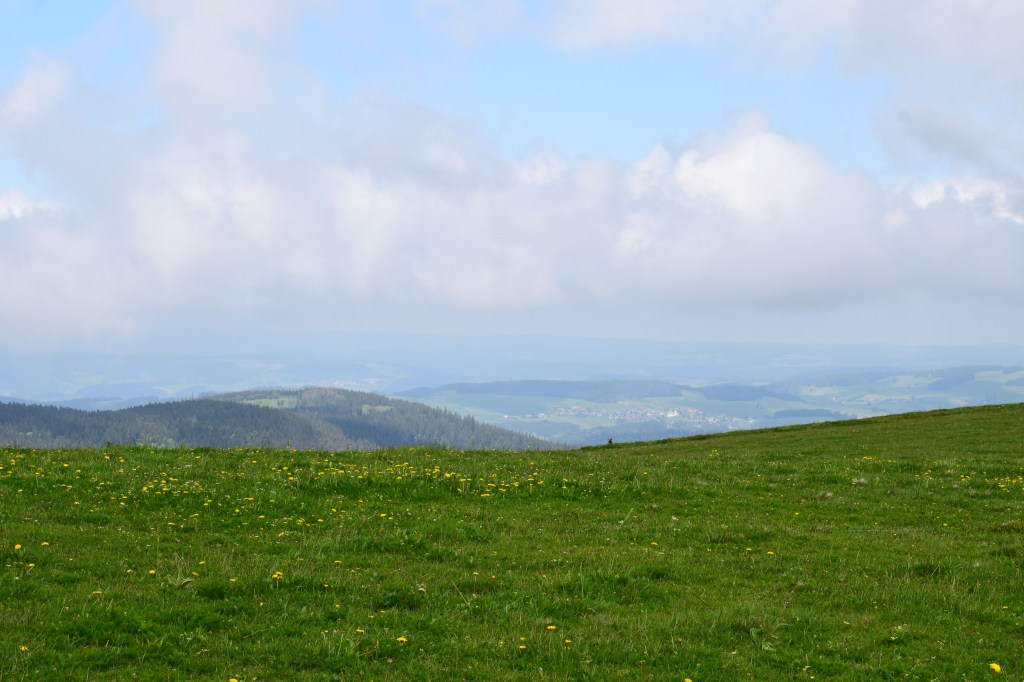


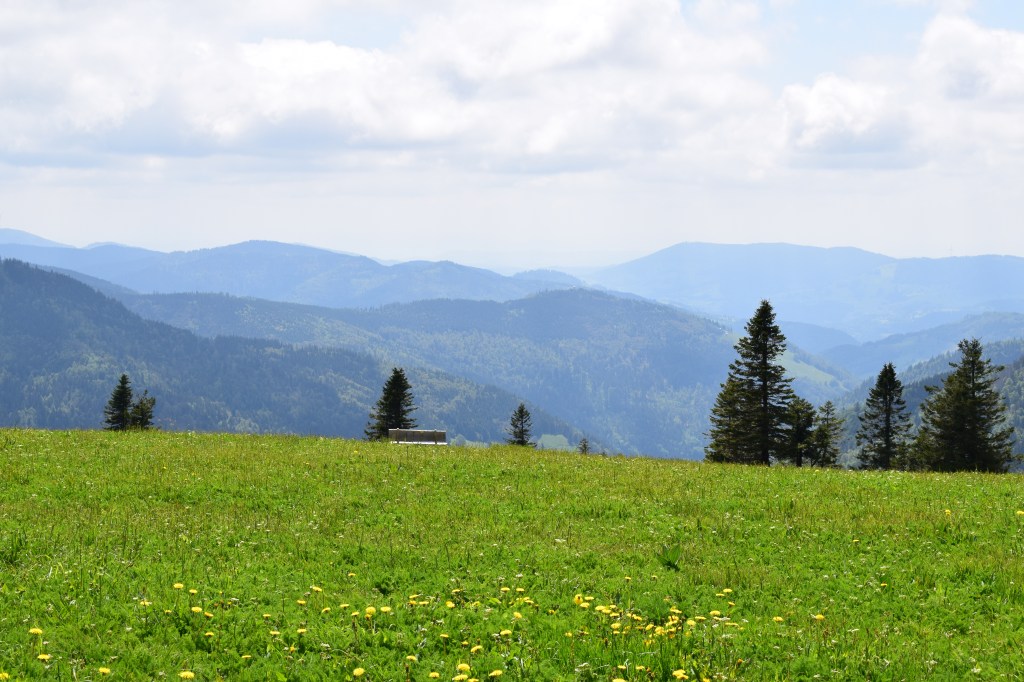

Open areas are habitats for specialized species of flora; including bogs, moors, rock faces and snow fields. Below the summit the mountain is covered by mixed forest comprised of European beech, European rowan, European spruce, European silver fir as well as cultivated North American species Douglas fir. Human activity has resulted in forest clearings, particularly around every quaint town. This has primarily been done to promote cattle farming
How to Visit:
The Feldberg Mountain features hotel, outdoor cafes, souvenir shops, ample parking for winter skiing and summer hiking. It even has a well respected nature center- Haus der Natur (House of Nature).
The Feldberg can be hiked or one can take the cable car and hike the remaining 2km (1 mile) to the Feldberg tower which can be climbed. Details on the Feldberg cable car, including prices, can be found here: https://www.feldberg-erlebnis.de/en/summer/tickets-prices


 Onward Trip