
-Abbot Suger
- Who Was St. Denis
- Why is the Basilica Historically Important?
- Abbot Suger
- Evolution of a Basilica:
- West Facade:
- How To Get Here:
- Admission:
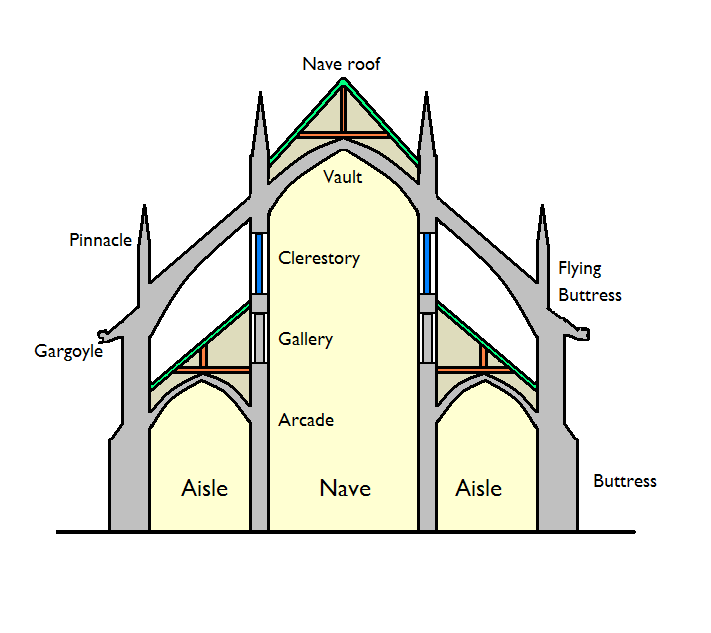
- Diagrams of a Gothic Cathedral
Who Was St. Denis
Denis was born in Rome and was a third century bishop in Paris. He likely suffered persecution under Emperor Decius and, by 250 CE, was martyred at Paris’ peak Montmartre. St. Denis’ statue of the saint himself is the most famous Catholic cephalospore, or depiction of a person who carries their severed head. Traditionally, St. Denis’ postmortem was raising his severed head and speaking a sermon while walking several miles. The place where he supposedly finally fell was initially marked by a church that, over time, expanded into the current Basilica and supported the St. Denis region’s enlargement.

St Denis statue, Left Portal, Notre Dame de Paris
Why is the Basilica Historically Important?
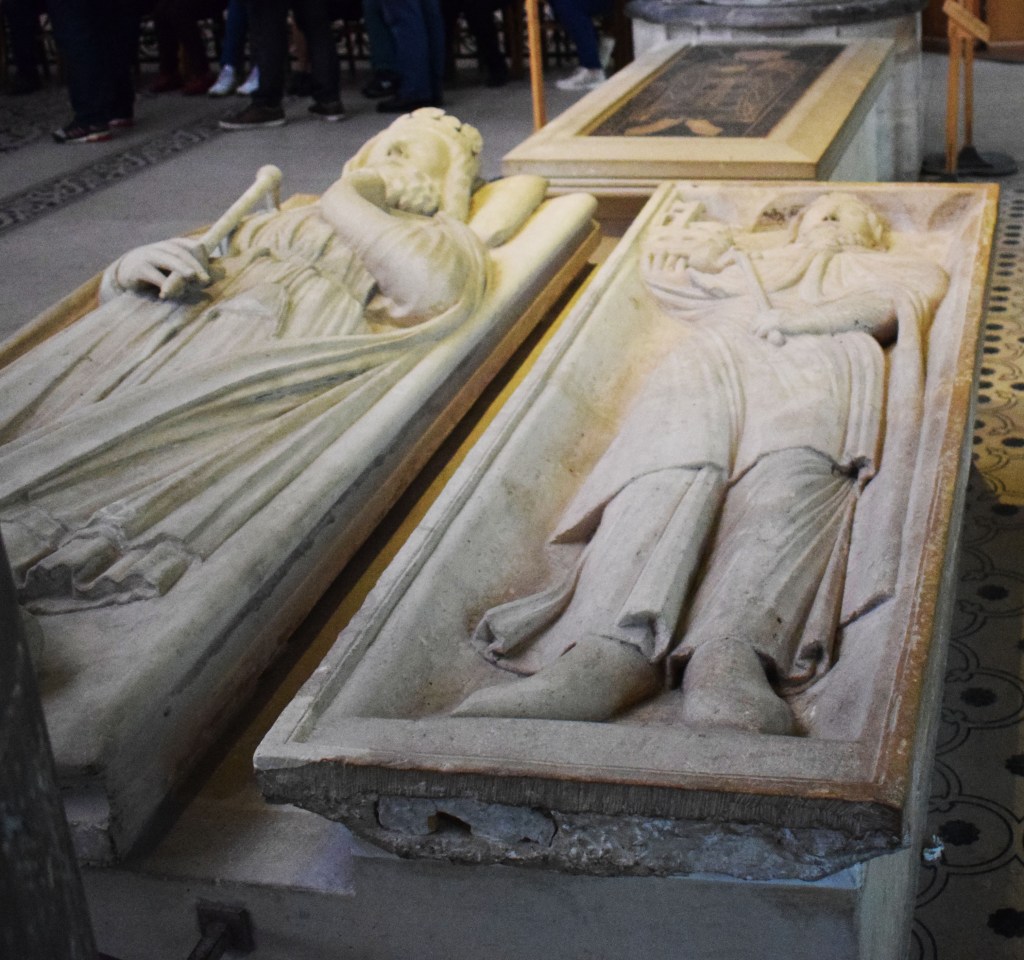
The site was a Gallo-Roman cemetery when Ancient Rome reigned, its archeological remains beneath the basilica. Pagan and Christian burial practices are indicated by these. The basilica turned into a place of pilgrimage and later a necropolis. It contains the tombs of nearly every French king from the 10th century to the 19th century’s King Louis XVIII. King Henry IV renounced his Protestant faith and adopted Catholicism here. Queens of France were crowned at the basilica. Royal regalia, e.g. the king’s coronation sword and scepter, were stored at the basilica. It was targeted during the French Revolution. On Friday 14, September 1792, the monks celebrated their last services in the abbey church; the monastery was dissolved the next day. The church was thereafter used to store grain and flour. In 1794, the government decided to remove the lead tiles from the roof to melt them into bullets; it left the church interior badly exposed to the weather.

Abbot Suger
Suger was born to peasant parents in 1081. He was educated by monks near St. Denis. One of his schoolmates was Louis Capet, later Louis VI in 1108. Eventually Suger was a secretary to Abbot Adam and a confidante to the king. Suger’s administrative travels took him to England, where he was impressed with the orderly organization contrasting France’s feudal disarray. Suger believed it was essential for the king to protect poor and middle class citizens.
Suger was elected in 1122. When Holy Roman Emperor Henry V tried to enter his lands, King Louis VI rode out under the St. Denis’ Oriflamme banner and intimidated Henry V into leaving without a fight. Suger encouraged priests to resume a more pious life. After Louis VI’ s death, Suger turned his attention to St. Denis’ restoration.
Evolution of a Basilica:
First: Martyrium or shrine or mausoleum was built on the site of his grave about 313 AD; later tomb and monument additions per St. Genevieve transformed it to a basilica.
Second: Carolingian Church or Abbey: Following his coronation, King Pepin the Short vowed to rebuild the old abbey. The first church was begun in 754 and completed under King Charlemagne around 775.
The most popular St. Denis foundation myth tells of a leper who slept in the nearly done church the night before its consecration. The leper witnessed a blaze of light from where Christ, St. Denis and a host of angels emerged to conduct the consecration ceremony. Before leaving, Christ tore off the leper’s diseased skin to revel a perfect complexion. A marble column’s misshapen patch was said to be the leper’s discarded skin. By tradition consecrated by Christ, the building’s fabric was thus regarded as sacred.
This structure was 262 feet (80 meters) long, the nave divided into 3 sections flanked by two rows of marble columns, a transept and an apse. 1,250 lamps were lit during celebrations. A holdover from Rome’s St. Peter’s Basilica is a confession or martyr’s chapel in a crypt beneath the apse. St. Denis’ remains are here. His companions Rusticus and Eleutherus, martyred with him, are on each side of him.

Thirdly: The Basilica: the abbey was the Basilica by Abott Suger. Construction began in 1135.
The following resources are excellent to learn more about Suger’s work on the building and its conversion to a sanctuary for French Royals.

https://www.amazon.com/Abbot-Suger-Abbey-Church-Treasures/dp/0691003149

https://www.cuapress.org/9780813237084/selected-works-of-abbot-suger-of-saint-denis/
On https://www.thegreatcourses.com/professors/william-r-cookDVD or Amazon Prime- The Great Courses by the Teaching Company: Cathedral by William R. Cook
Suger’s First Phase: WEST FRONT 1135 to 1140: the old Carolingian church was demolished; the nave extended westwards by 4 more bays, a western narthex, three first floor chapels and a new facade.
Massive vertical buttresses by then separated the three doorways; horizontal string-courses and window arcades clearly marked the divisions. Clearly delineating parts of the church was a common theme in Gothic architecture, a departure from Romanesque. The portals were sealed by gilded bronze doors ornamented with scenes from Christ’s Passion. Suger’s patronage was known by the following inscription:
Receive, stern Judge, the prayers of your Suger, Let me be mercifully numbered among your sheep
NOTE: you can specifically locate this: On the lintel below the great tympanum showing the Last Judgement, beneath a carved figure of the kneeling Abbot.
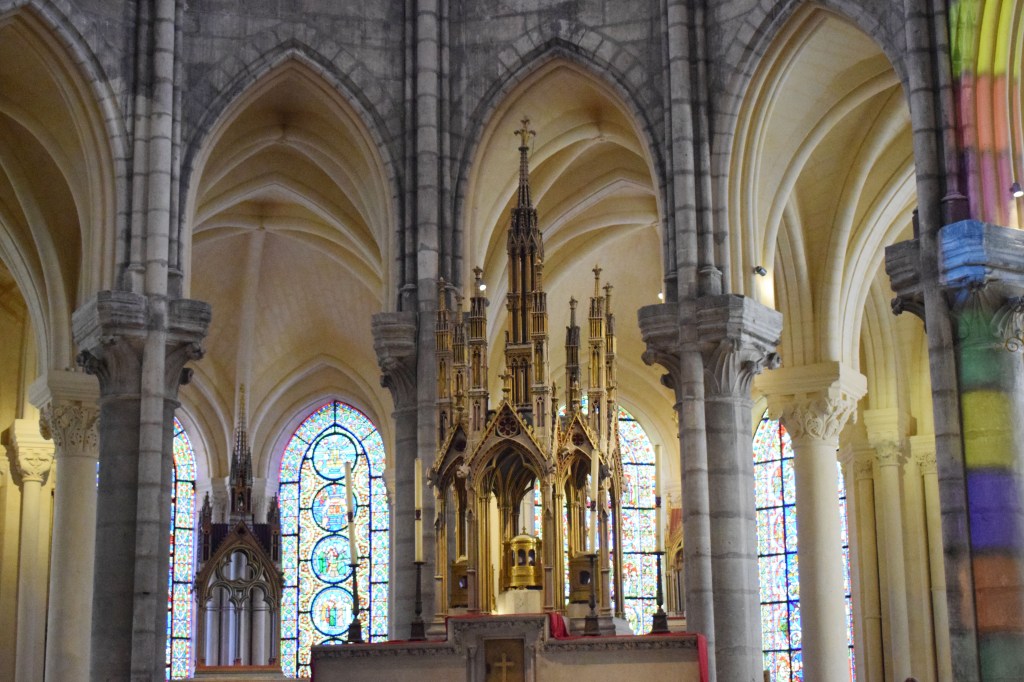
Second Phase: the New Choir 1140 to 1144: Suger replaced heavy dividing walls with slender columns. He said regarding the change: “A circular string of chapels, by virtue of which the whole church would shine with the wonderful and uninterrupted light of most luminous windows, pervading the interior beauty.” Suger incorporated some Romanesque architecture, including rib vaults with pointed arches, exterior buttresses allowing for larger windows, and a reduction of interior walls making way for more light.
Symbolism: The choir’s twelve columns represent the twelve Apostles, and the light represents the Holy Spirit. Suger’s words carved in the nave: “For bright is that which is brightly coupled with the bright, and bright is the noble edifice which is pervaded by the new light”.
West Facade:
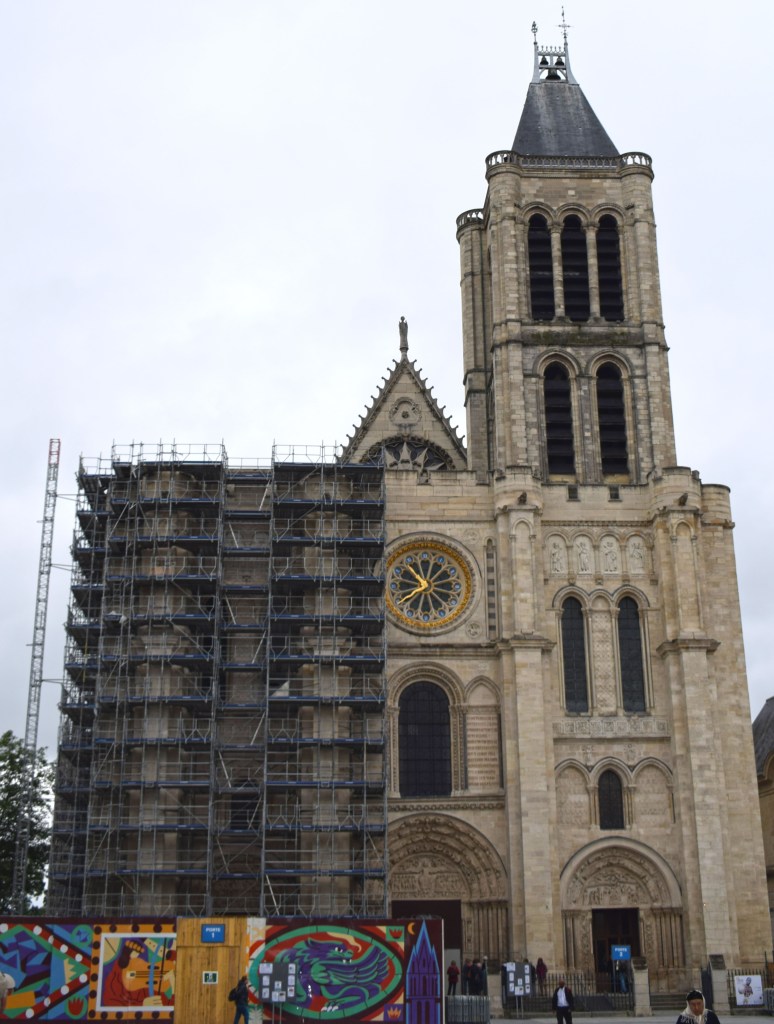
Dedicated in 1140, the entrance’s 3 sections (the center the largest) are each bestowed their own door. Above the doors is a 3 story elevation. Where two towers also stood above the doors, the North tower was destroyed in an 1846 tornado (Europe gets them too, most often in northwestern Germany), leaving only the South Tower standing today. Above the center door is a Gothic feature imitated throughout the area (including Chartres): a central rose window within a square structure.
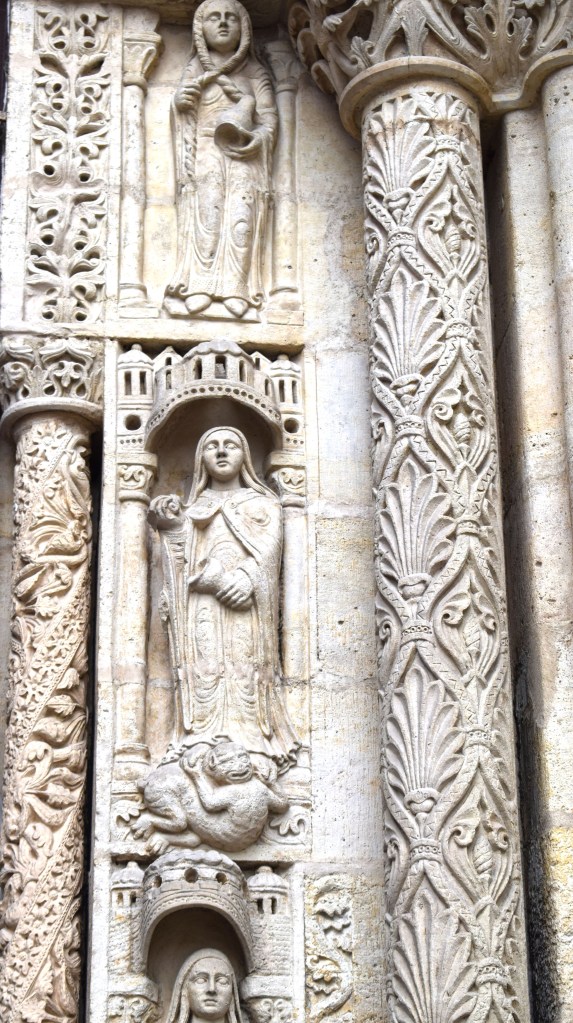
North Portal: Porte de Valois was built near the end of Suger’s life. Six figures are in the embrasures (Jamb statues) and thirty figures are in the voussures, or arches above the door, representing kings (perhaps Old Testament monarchs). The tympanum over the door illustrates the martyrdom of Saint Denis and his companions Eleuthere and Rusticus.
South Portal: The central tympanum shows the final days of Denis, Eleuthere and Rusticus. The pierdroits are filled with labors connected with each month.
Interior: Its original version differed from its later. Walls were three-leveled; large arcades of massive pillars were on the ground floor; a narrow windowless triforium or passageway was midway up the wall; and a row of high windows was at the clerestory above. Slender columns rose from pillars up the walls to support four-part rib vaults. The Rayonnant reconstruction gave the triforium windows. The upper walls were entirely filled with glass reaching upward into the vault arches. The chevet was constructed by Suger in a record time four years between 1140 and 1144. It was one of the first great realizations of Gothic architecture. The double disambulatory is divided not by walls but by two rows of columns, while the outside walls, thanks to exterior buttresses, are filled with windows. The new system allowed light to pass into the interior of the choir. The disambulatory connects with the five radiating chapels at the east end of the cathedral, each with their own large windows. To give them greater unity, the five chapels share the same vaulted roof systen. To make the walls between the chapels less visible, they’re masked with slender column networks and tracery.





How To Get Here:
There are multiple ways to get to the Basilica of Saint-Denis from Paris, including by metro, bus, train, or car:
- Metro: Take line 13 to the Basilique de Saint-Denis station, which is about a 30-minute ride from Paris. Basilica is 100 meters- follow the steeple and signs.
- Bus: Lines 11, 153, 239, 253, and 274 stop near the basilica.
- Train: Take the RER D or Train H line from Gare du Nord station. Upon arrival walk 15 min on foot or take Tramway T1 about 5 minutes- passes directly.
- Tram: Take the T1 tram line, which passes near the basilica.
- Car: Take the A1 highway from Porte de La Chapelle, then exit at Saint-Denis – center ville. Follow the green sign “Saint-Denis Centre” to the Indigo Parking named “Basilique”.
- Drop-off: If you have a disability, you can be dropped off in front of the basilica and park at a nearby parking lot.
Admission:
Sainte Denis Website: https://www.saint-denis-basilique.fr/
From April to September
Monday to Saturday: 10 a.m. – 6:15 p.m. (last admission at 5:45 p.m.)
Sunday: 12 p.m. – 6:15 p.m. (last admission at 5:45 p.m.)
October to March
Monday to Saturday: 10 a.m. – 5:15 p.m. (last admission at 4:45 p.m.)
Sunday: 12 p.m. – 5:15 p.m. (last admission at 4:45 p.m.)
Closed during religious services and on January 1 , May 1 and December 25.
The rates below are applied from January 1, 2024.
| Individual rate | 11 € |
| Combined ticket Basilica of Saint-Denis / PantheonBenefit from a preferential rate for visiting the two monuments in the Centre des monuments nationaux network (3 days between the two visits). | 19 € |
| Free Under 1818-25 years old (nationals of European Union countries and regular non-European residents on French territory on presentation of an identity document)Disabled person and their companionJob seeker (upon presentation of a certificate less than 6 months old) Education pass (valid)Free on Heritage Day weekends and the first Sundays of the month from November to March.On presentation of a valid Paris Museum Pass (PMP). On presentation of a ticket generated via the Paris PassLib’.Students in architecture school |
Payment Methods:
bank cards, check, Culture check, holiday voucher (ANCV), Read check (in store only)
Diagrams of a Gothic Cathedral


 Onward Trip